Showing posts with label 2010. Show all posts

2010 Lamborghini Murcielago LP 650-4 Roadster


Automobili Lamborghini has released the first photographs of a limited edition Murciélago LP 650-4 Roadster. The Roadster version of the Murciélago will offer an uprated 6.5 litre V12 engine that produces 650 hp (478 kW) along with permanent four-wheel drive: hence the model’s LP 650-4 moniker. With 660 Nm of torque, top performance is at 0-100km/h (0-62mph) in 3.4 seconds. The top speed is around 330 Km/h (205mph).


The special edition model will be produced in a limited volume (50 units only), with a Grigio Telesto exterior that combines grey bodywork with a special bright orange Arancio LP 650-4 featured on the front spoiler and sills. The LP 650-4 logo applied to the car’s exterior is recognition of the car’s increased power. The car features orange brake calipers and a transparent V12-engine cover, which shows off the V12 engine behind the driver.

Interior features echo the car's striking grey-and-orange exterior: besides the orange touches, there is an asymmetric dash design, with black Alcantara Nera on the driver's side, including door panel and central tunnel, and black leather Nero Perseus on the passenger's side.


The increased power of the Murciélago engine, from 640 to 650 hp, will be unique to the Murciélago LP 650-4 Roadster: it demonstrates even further the developments that Lamborghini is able to offer from a current engine, and creates the exclusive characteristic of the Murciélago LP 650-4 Roadster.

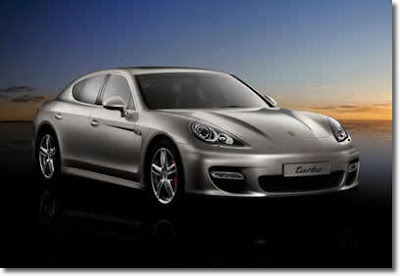
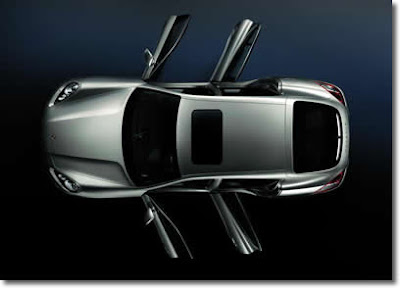
2010 Porsche Panamera Gran Turismo Turbo


Porsche has confirmed UK prices for its forthcoming four seat Panamera gran turismo, which goes on sale on 12 September 2009. The four door performance car will be priced from £72,266 for the Panamera S, £77,269 for the Panamera 4S and £95,298 for the top of the range Panamera Turbo.

The Porsche Panamera will be available with powerful and efficient V8 power units, the choice of rear or four-wheel drive, and an interior design with a uniquely luxurious and high technology ambience.

The rear-wheel drive Porsche Panamera S is offered with a six-speed manual gearbox. The seven-speed Porsche Doppelkupplungsgetriebe (PDK) double-clutch transmission is available as an option for £2,289. The Panamera 4S and Turbo have four-wheel drive and feature the PDK gearbox as standard. The active all-wheel drive system is controlled by Porsche Traction Management (PTM) via a multi-plate clutch that adjusts the engine power distribution between the front and rear axles for increased grip and agility.

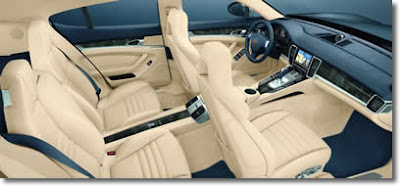
The Porsche Panamera offers a unique symbiosis of sporting performance and sheer luxury. Every model offers a full leather interior, Porsche Active Suspension Management (PASM), Bi-Xenon headlights, rear ParkAssist, tyre pressure monitoring, automatic dimming rear view mirrors, Porsche Communication Management with touch-screen satellite navigation and audio controls, and a Bluetooth telephone module – complete with cordless handset for use by rear seat passengers.

The heated front seats fitted as standard in the Panamera S and 4S are of a sporting style, and can be adjusted electrically in eight different directions for optimum comfort. Adaptive sports seats with higher side bolsters are available as an option across the range.


Standard on all Panamera models is the ‘Sport’ button, which increases throttle pedal responsiveness, selects the ‘Sport’ suspension setting on the PASM, and the shift patterns of the PDK transmission, where fitted. Offered in combination with PDK is the new Porsche Auto Start/Stop function. This automatically switches off and restarts the engine when stationary to further reduce fuel consumption and emissions – for example, at traffic lights or in congestion.

The Panamera S and 4S have 18-inch alloy wheels as standard, with a choice of 19-inch and 20-inch alternatives available. The Panamera Turbo rides on 19-inch alloy wheels. As is typical of a Porsche, the braking system of the Panamera is designed to deliver a high level of stopping power. However, similar to all other Porsche models, the race-proven and highly efficient Porsche Ceramic Composite Brake (PCCB) option is also offered for the Panamera.

Additional features on the Panamera Turbo include PASM with an adaptive air suspension function that actively adjusts the ride height, BOSE® Surround Sound audio system with 14 speakers, metallic paint, multi-function steering wheel, heated rear seats and rear side airbags. Also, the 14-way electric front seat adjustment has a Comfort Memory Package for the various seat positions and the electrically adjustable steering column.

The Panamera offers comprehensive levels of active and passive safety across the range. In addition to Porsche Stability Management (PSM), there are driver and front passenger airbags, curtain airbags as well as – on the front seats – side and knee airbags, each ensuring maximum protection as standard features in the event of an accident. Rear seat side airbags are available as an option on the Panamera S and 4S.


A luxurious journey is guaranteed in any of the four seats in the Panamera but, for passengers in the rear, the option of electrically adjustable backrests, cushion length and lumbar support raises the standard further still. It is also possible to specify rear seat ventilation, and a comprehensive rear interior illumination package with high power reading lights.

For customers seeking the ultimate in-car audio experience, the Panamera is the first Porsche to offer the option of a High-End Surround Sound System from Burmester®, the renowned Berlin audio specialist. A total of 16 loudspeakers masterminded by 16 amplifier channels with an overall output of more than 1,000 watts provide a unique sound, complemented by an active subwoofer together with a 300 W Class D amplifier.

The superior, yet practical, driving qualities of the Panamera are borne out clearly by the luggage compartment. Opening the rear lid reveals a load capacity of 445 litres (15.6 cu ft) in the Panamera S and 4S. Maximum stowage in the Panamera Turbo is 432 litres or (15.1 cu ft). With the rear seat back rests folded, luggage capacity in all models increases to an ample 1,250 litres or 43.8 cu ft.

Every Panamera has the assurance of a Porsche Vehicle Tracking System (VTS), a sophisticated vehicle security package approved to Thatcham Category 5 standard, and customers will also be able to explore the potential of their new car by participating in a complimentary course at the new Porsche Driving Experience Centre, Silverstone.

2010 Maybach 57 Zeppelin


Stuttgart – The Maybach brand is bringing out the new Maybach Zeppelin to spearhead its luxury saloon model range. The newcomer represents the absolute zenith in the high-end luxury saloon segment. This makes it a worthy successor to the legendary Maybach Zeppelin, which was revered worldwide as the ultimate in high-class automotive engineering in the 1930s. The hallmark features of the new Maybach flagship’s unique sense of style include a stunning paint finish, featuring a shoulderline in a contrasting colour, as well as the exquisite, meticulously crafted materials in the interior, whose long list of optional extras includes a world first – a highly sophisticated perfume atomiser. The new model's performance outclasses the rest of the Maybach range, making it the most powerful Maybach ever. In a nutshell: the Maybach Zeppelin epitomises stylish elegance and vehicle manufacture as no car has ever done before. The new Maybach Zeppelin is being built in a limited edition of 100 worldwide.

A Maybach brochure dating from 1930 clearly sets out the firm’s stall: “To create only the very best from the very best – a car that fulfils every last wish and stands out for its supremely refined elegance and power.” At that time, Karl Maybach had developed a luxury car, the likes of which had never been seen before. Maybach derived the design of its mighty twelve-cylinder drive unit from the same engine he had developed to power the daring airships of aviation pioneer Ferdinand Graf von Zeppelin. Inspired by the Count’s visionary personality, he christened Germany’s first ever series-production twelve-cylinder car “Zeppelin”, and offered it to a highly discerning (and solvent) clientele with a displacement of either seven or eight litres (150 hp or 200 hp).

Even today, the name “Zeppelin” has an incomparable ring to it in the realm of high-end luxury cars. As the flagship model in today’s range of Maybach Saloons, the new Maybach Zeppelin does justice to its branding. The name is not merely intended to rekindle memories, after all: as in bygone times, Maybach is once again building the Maybach Zeppelin for distinguished drivers who are seeking something extra special, even in this most luxurious of automotive segments. Not only do the Maybach 57 Zeppelin and Maybach 62 Zeppelin stand out for their exquisite elegance, inventive ideas and phenomenal performance.

Yet greater power for the Maybach Zeppelin

The Maybach 57 S and the long-wheelbase version, the 62 S, serve as the technical basis for the new range-topping model. Supreme performance is assured in both cases by the 6.0-litre V12 biturbo power unit under the bonnet, which has been further refined by Mercedes-AMG and now delivers 471 kW/640 hp (+ 28 hp) and an electronically limited peak torque of 1000 Newton metres. The models’ extra-special status is documented in befitting fashion by a plaque in the engine compartment, which is engraved with the inscription “MAYBACH ZEPPELIN – ONE OF 100”. If the customer so wishes, a reference to their vehicle’s limited nature can be included in the passenger compartment too.

Needless to say that both versions of the Maybach Zeppelin have extraordinary performance capabilities. The decidedly sporty Maybach 57 Zeppelin for owners who enjoy taking the wheel themselves races to 100 km/h from standstill in 4.9 seconds and attains an electronically governed top speed of 275 km/h. The Maybach 62 Zeppelin, which is conceived first and foremost as a chauffeur-driven car, completes the 0 - 100 km/h sprint in 5.1 seconds and has a limited top speed of 250 km/h.


A two-tone exterior identifies the new Maybach flagship

Whatever angle it is viewed from, the new Maybach Zeppelin radiates character and the sort of style which appeals to all the senses. From the outside, the luxury brand’s new top-of-the-range model can be recognised by its two-tone special paint finish which is applied in a long series of steps. The shoulderline is painted right through to the background of the headlamp assemblies in Rocky Mountains light brown, forming a stylish and scintillating contrast to the Taiga black finish used for the rest of the vehicle body while reinforcing the impression of three-dimensionality too. Naturally, customers may also specify any other paint finish of their choice for their Maybach Zeppelin. Dark red tail light units and a fine vertical partition in the tailpipe add striking visual touches at the rear.

The Maybach's newly designed elegant 20-inch wheels in a Chrome Shadow finish complete the picture. These were first painted with a black undercoat, before having a silver topcoat applied using an elaborate painting process that causes the tone to gradually increase in darkness from the outside in.

The streamlined exterior mirrors, which produce even less wind noise, are new to Maybach. They have a more angular design and are separated from the door frame by a slender arm, giving them a more expressive look. They also feature an enlarged mirror surface together with integral indicators in the shape of a horizontal “V” for even greater perceptual safety.

The curving “ZEPPELIN” lettering that appears below the distinctive double “M” emblem on the radiator grille and on the boot lid instantly gives away the elite status of the Maybach Zeppelin.

Finest-quality leather and high-gloss piano lacquer trim

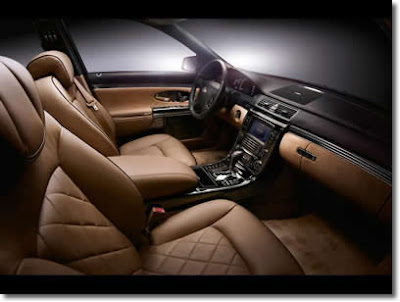
The new Maybach Zeppelin is a car for connoisseurs, as is immediately apparent from its interior. Here, the luxurious leather appointments in California beige leather form a delightful contrast with the exclusive leather in deep Stromboli black that gives added impact to the shoulderline on the inside too – elegantly mirroring the exterior’s colour scheme in the process. At the same time, the lustrous deep black tone of the leather harmonises beautifully with the exquisite piano lacquer finish of the trim elements. The precisely crafted contrasting topstitching in the dashboard and on the doors reinforces the Maybach Zeppelin’s sense of dynamism. The unusual diamond quilting pattern on the seat cushions and backrests together with the black piping gives the opulently styled seats a character all of their own. The occupants’ feet rest on genuine lambskin carpeting.

The limited-edition special models bear a number of discreet identifying markings in the interior too. The centre console in the front, the partition screen that is available as an option for the Maybach Zeppelin 62, plus the silver champagne flutes included as standard are all marked with the lettering “MAYBACH ZEPPELIN”, while the door sill panels as well as the key ring are engraved with the word “ZEPPELIN”.


World first – a system for a fine interior fragrance

Customers are also able to opt for an especially refined equipment detail that is exclusive to the Maybach Zeppelin – an imaginatively designed, extremely high-quality perfume atomiser, the only one of its kind in the world. It easily eclipses all previous efforts to produce something similar, both in terms of its visual appeal and its operation. Its sophisticated technology and premium fragrances create a unique aromatic experience in the Maybach Zeppelin’s interior at the push of a button – stimulating the senses of the occupants not with an overpowering perfume but with a soft, delicate scent.

The system’s core component is an internally illuminated Plexiglass sphere on the rear centre console, into which Maybach Zeppelin owners can insert a vial of their preferred fragrance. Underneath the sphere’s base, which is finished in piano lacquer, there is a dedicated regulator pump. At the push of a button, this compressor draws in pre-purified from the vehicle’s interior and directs it into the Plexiglass sphere in a gentle stream. The airstream passes through four apertures in the top of the vial’s cap, allowing it to carry perfume molecules from the tip of the cap into the vehicle interior. Air which has been suitably purified by the vehicle’s own climate control system also flows out of a ventilation outlet at the bottom of the sphere, thereby helping to distribute the scented air throughout the passenger compartment.

The ingenious control understands the human sense of smell

The perfume atomiser can be activated either from the driver’s seat or by means of a button in the rear centre console, with an additional thumbwheel in the rear for sensitive aroma control. The chosen fragrance gently wafts into the passenger compartment within ten to twelve seconds. On models with a partition screen, only the passengers in the rear are able to activate the atomiser.

The aroma experts took the human sense of smell into consideration when designing the control mechanism. As the nose adjusts to smells in such a way that it no longer perceives them after a short while, the perfume atomiser switches off after about ten minutes to prevent the occupants’ sense of smell from being overwhelmed to the point where they can no longer enjoy the fine aroma. Once the system has switched off, the fragrance quickly evaporates. Thanks to the sophisticated control and the high-quality perfumes used, the fragrance does not seep into either the interior’s materials or the occupants’ clothes.

Reactivating the atomiser later allows the aromatic experience to be enjoyed all over again.

Artistic, hand-blown vials and specially developed fragrances

The system comes supplied with two select fragrances, which have been exclusively developed for the Maybach by a renowned perfumer from global specialist Givaudan: one light and refreshing, the other woodier, richer and heavier, making it an ideal complement to the interior of the Maybach Zeppelin. The foundation for the latter is agar, the most expensive wood in the world, which is burned in the Japanese ‘ko-do’ incense ceremony.

Maybach Zeppelin owners can also use other fragrances, or even have one specially developed and enjoy the luxury of immersing themselves in their very own, personally designed aroma. The fragrance holders are easily interchangeable, allowing owners to quickly switch between two or even three scents to suit their mood, fashion, style or sense of wellbeing, for instance. The specification includes a total of three valuable vials, which are hand-blown by a well-known glass artist.

The elaborate, silent-running perfume atomiser system is a patented Maybach innovation that was developed in-house.

The Maybach 57 Zeppelin costs €406,000, the Maybach 62 Zeppelin has a price tag of €473,200 (German list price, excl. VAT). The perfume atomiser that is exclusive to the Maybach Zeppelin can be ordered for an extra €3950 (German list price, excl. VAT).

2010 Lamborghini Murcielago LP670-4 Superveloce


2010 Lamborghini Murcielago LP670-4 Superveloce
The Lamborghini Murciélago is one of the most extraordinary super sports cars of all time. Automobili Lamborghini has now expanded its model range with a new, exceptionally purist and even more extreme top model – the Murciélago LP 670-4 SuperVeloce is even more powerful, lighter and faster than the Murciélago LP 640. With the output of the 6.5 liter V12 increased to 670 hp and a weight reduction of 100 kg (220 lbs), the Murciélago LP 670-4 SuperVeloce boasts a power-to-weight ratio of 2.3 kg (5.1 lbs) per hp. This catapults it from 0 to 100 km/h (62 mph) in a breathtaking 3.2 seconds and powers it on to a top speed of around 342 km/h (212 mph). Distinctive design refinements ensure that each of this 350-unit limited edition series conveys its full potential from the very first glance.

With its outstanding performance, razor-sharp precision and exceptional high-speed stability, the Lamborghini Murciélago LP 670-4 SuperVeloce is the ultimate performance car for advanced sports car drivers. The super sports car has been extensively redesigned with a new front and rear, an innovative engine bonnet and a choice of two aerodynamic set-ups featuring either a small or large rear spoiler. The interior in Alcantara and carbon fiber provides a purist and minimalist approach.

In order to achieve the substantial weight reduction of 100 kilograms (220 lbs), the Murciélago LP 670-4 SuperVeloce was extensively reworked and redeveloped in virtually every aspect – from chassis to engine and transmission, right through to the interior. The increase in engine output from 640 to 670 hp is the result of optimized valve timing and a reworked intake system. The significantly modified aerodynamics with substantially increased downforce brings considerable improvement to vehicle stability at very high speeds. With the small standard-fit rear spoiler, top speed stands at 342 km/h (212 mph), while the large "Aeropack Wing" and its added downforce gives a top speed of 337 km/h (209 mph).

"The new Murciélago LP 670-4 SuperVeloce is the systematic continuation of our brand philosophy. It is more extreme and uncompromising than virtually any other automobile," says Stephan Winkelmann, President and CEO of Automobili Lamborghini. "As the new top model of the highly successful Murciélago range, the SuperVeloce displays not only outstanding driving dynamics, it is also further evidence of our company's technological expertise. Customers can look forward to an utterly unparalleled driving experience."

Design and aerodynamics

The Murciélago is an icon of the Lamborghini brand – a sports machine of menacing character and brutal power. Its unique design radiates a supreme form of highly concentrated sensuality. Wide, low, with its glass area pushed way forward and a long, taut back – the interplay between the soft contours of the basic form and razor sharp edges is the perfect expression of the Lamborghini design language. In the totality of its character, the Murciélago is without comparison on the sports car market.

Yet even a character like this can be further refined – the new Lamborghini Murciélago LP 670-4 SuperVeloce is the more extreme, even more purist pinnacle of the model range. This is clearly evident from the very first glimpse of its completely redesigned front end – pulled way forward and finished in matt black paint, the carbon fiber front spoiler is connected to the front end via two vertical elements. The large air intakes for the front brakes are more powerfully emphasized. The new front fenders feature additional air intakes for brake ventilation. The air vent for the oil cooler located in the driver-side sill area is painted matt black to match the sills.

The modifications are even more apparent around the mighty engine bay of the Murciélago LP 670-4 SuperVeloce. The twelve-cylinder engine is presented as an engineering masterpiece under a transparent engine bonnet that boasts a completely new architecture. Hexagonal polymer plates made from transparent polycarbonate are set on three levels within a carbon fiber framework. The layers are open towards the rear, playing a key role in the thermodynamics of the high-performance engine.

The impressive rear end of the SuperVeloce is dominated by a veritably noble, flat and extremely wide exhaust tailpipe and, on the underside, by a two-level diffuser system finished entirely in carbon fiber. The rear light clusters display their signals in that distinctive Y-shape that has been a fixed element of Lamborghini design since the Murciélago LP 640, Reventón and Gallardo LP 560-4. The panel between the lights is made from carbon fiber, while the large intake mesh below expands across the full width of the rear end. Made from thick-walled aluminum, the hexagonal pattern is laser-cut and a Teflon coating provides the necessary heat protection.

The aerodynamics of the Murciélago LP 670-4 SuperVeloce have been completely redeveloped. Alongside the enlarged front spoiler and the twin rear diffuser, the new fixed rear spoiler also plays an important role. Customers can choose between two versions, with the small rear spoiler providing improved downforce at high speeds. As an option, the Murciélago LP 670-4 SuperVeloce can be supplied with the "Aeropack Wing" – a large, fixed, carbon-fiber wing mounted on two carbon-fiber brackets. The new aerodynamic set-up provides a significant boost to directional stability at the very highest speeds. The top-speed downforce on the Murciélago LP 670-4 SuperVeloce with Aeropack is strongly increased.

2010 Lamborghini Murcielago LP670-4 Superveloce
Bodyshell and lightweight construction

With the construction of the Murciélago LP 670-4 SuperVeloce, Lamborghini proves its expertise in the manufacture of lightweight materials and in working with hi-tech carbon fiber. The structure of the super sports car is a composite construction of extremely stiff carbon components and a tubular steel frame – as in a race car. The transmission tunnel and the floor are made of carbon fiber, attached to the steel frame using rivets and high-strength adhesives. The roof and the exterior door panels are formed in sheet steel, while the remainder of the outer skin is made from carbon composite material.

For the Murciélago LP 670-4 SuperVeloce, engineers in Sant'Agata Bolognese recalculated the framework and selected a new, super high-strength sectional steel. This achieved two objectives – on the one hand, they increased the torsional stiffness of the chassis by 12 percent to provide improved handling precision and, on the other, they were able to reduce weight by 20 kg (44 lbs), making a significant contribution to the reduction of overall vehicle weight. And the systematic approach to lightweight design continues throughout the entire bodyshell. The front fenders, the rear side panels/fenders and the casing for the third brake light are made of a modified carbon-fiber material. Combined with the removal of the drive for the moveable spoiler, this brings a further weight reduction of 13 kg (28.6 lbs).

Added to the 33 kg (72.6 lbs) of weight reduction from the chassis and exterior, are 34 kg (74.8 lbs) from the interior, as well as over 33 kg (72.6 lbs) removed from the engine and drive train.

Power unit and transmission

The longitudinally mounted 6.5 liter V12 delivers the infernal power for an unparalleled driving experience. With 670 hp (493 kW), the engine in the Murciélago LP 670-4 SuperVeloce is 30 hp more powerful than in the Murciélago LP 640. The twelve-cylinder sends its mighty 660 Nm (487 lb-ft) of torque to the crankshaft at 6,500 rpm; maximum power is reached at 8,000 rpm, with an average piston speed of 23.7 meters per second – a figure almost comparable to race engines.

The V12 is eager to deliver its performance – it brings its menacing power with immediacy and precision to guarantee breathtaking performance – after only 3.2 seconds the SuperVeloce has already reached 100 km/h (62 mph).

The engine block and heads of the V12, positioned at the ideal cylinder angle of 60 degrees, are made from aluminum. The four chain-driven camshafts are variably controlled, while the intake manifold operates in three stages – both technologies add even greater thrust to the merciless pushing power. To increase the performance of the SuperVeloce, the intake system was modified, the valve train optimized and, most importantly, valve travel was increased.

The control electronics for the V12 were developed internally by Lamborghini - each cylinder bank has its own high-performance processor. If the engine needs more cooling air, intake funnels emerge from the rear pillars: when not in operation, they lie flush with the bodyshell. Dry sump lubrication enables the V12 to be mounted extremely low down, benefiting the handling dynamics: this also guarantees oil supply under extremely dynamic driving conditions. With 12 liters of lubricating oil in circulation, the oil cooler is located on the left side of the vehicle and cooled by air flowing through the aperture in the sill.

The weight reduction of more than 26 kg (57 lbs) in the engine area was derived primarily from the completely new exhaust system. The muffler has been redesigned and even the mighty tailpipe of the SuperVeloce manufactured from new materials is lighter than on the Murciélago LP 640. But most of all, the new exhaust system makes for an acoustic experience that is surely equal to the driving performance – from the heavy rumble of a stormy night, through the trumpeting of mighty elephants to the roar of a raging lion, the SuperVeloce performs the grand opera for 12 cylinders, 48 valves and 8,000 revs.

The SuperVeloce is equipped as standard with the sequential, automated manual transmission e.gear, which uses electro-hydraulics to shift gear extremely quickly and smoothly. A cockpit display informs the driver of the gear currently engaged. In addition a special "Corsa" mode and a "Low adherence" mode are available.

As a no-premium option, the SuperVeloce is available with a six-speed manual transmission. Its short metal shift stick runs in an open gate of classic Italian elegance. In both variants, the new lightweight clutch makes its own contribution to the weight loss program.

2010 Lamborghini Murcielago LP670-4 Superveloce
All-wheel drive and chassis

The Murciélago LP 670-4 SuperVeloce delivers its extreme power to the road with great reliability – assured by its permanent all-wheel drive. Before the rear wheels spin, the viscous coupling sends up to 35 percent of driving force via its additional shaft to the front wheels. The front and rear limited-slip differentials are set at 25 and 45 percent. With its four driven wheels and traction, the Murciélago delivers a decisive advantage over rear-wheel drive sports cars when it comes to accelerating out of a corner – and always with maximum stability. The rear axle bears 58 percent of its overall weight – a distribution ratio that is highly beneficial to traction.

Explosive dynamics, tenacious cornering and extreme speeds – the Murciélago LP 670-4 SuperVeloce is a super sports car packed with aggressive power, but by no means a mean-spirited car. Its steering requires very little power support, giving full control of the car to the driver. Those prepared to tackle the beast head on are quickly rewarded with intimate contact and trust – as speed increases, so the Murciélago reveals its strengths, thus exposing a character with no hidden surprises and behavior that can always be anticipated.

The Murciélago is fitted with double wishbone suspension all round. Spring struts – two on each of the rear wheels and one on each of the front – control the loads transferred from the road. The standard-fit lifting system enables the front end of the vehicle to be raised by 45 mm (1.8 inches) to avoid obstacles such as garage entryways. The SuperVeloce is equipped with exclusive "Ares" alloy-forged wheels, bearing the exclusive five twin-spoke design. The front wheels are clad in 245/35 ZR 18 rubber, while the rears sport 335/30 ZR 18. High-grip Pirelli P Zero Corsa tires come as standard.

Four brakes controlled by a hi-tech ABS system are capable of mighty stopping power when required. The Carbon Ceramic (CCB) brakes are fanned by cooling air flowing through enlarged channels in the bodyshell, while openings in the front fenders provide additional ventilation for the SuperVeloce. The ceramic discs are exceptionally lightweight, fade-free and capable of extremely high operational performance.


Interior and equipment

Even stepping into the Murciélago LP 670-4 SuperVeloce is an experience as individual as the vehicle itself. The upward-opening doors – a solution developed by Lamborghini in the early seventies for the Countach – are released via small latches, then swing wide open to reveal a panorama of the exclusive interior of the Murciélago LP 670-4 SuperVeloce. The dominating materials are Alcantara and carbon fiber, which make for an ambience that is as high-quality as it is sporty.

The sports bucket seats come as standard and provide exceptionally firm support around the hip and shoulder areas. The bucket seats are made from lightweight and highly robust carbon fiber and guarantee the driver perfect support, even in the most extreme driving situations. The Murciélago's standard seats are also available on the SuperVeloce as an option free of charge.

Not only the seats are upholstered in black Alcantara micro-fiber; the cockpit and the roof lining are also finished in this high-quality, lightweight material. The Y-shaped perforations on the seats and roof lining bring additional finesse, with an inlaid backing material in the same color as the exterior paintwork. The Murciélago LP 670-4 SuperVeloce can be delivered with the paint finishes Giallo Orion, Arancio Atlas, Bianco Isis, Grigio Telesto and Nero Aldebaran, as well as Bianco Canopus (white matt) and Nero Nemesis (black matt) as an option.

Naturally, the interior also makes its contribution to weight reduction. The door panels are clad in carbon fiber, as is the wide center tunnel. The application of Alcantara instead of leather is another weight-saver, just like the selection of sports bucket seats and the omission of the radio-navigation system (if requested, this is available as an option). At the end of the day, the music in a Murciélago comes from the engine compartment. Overall, modifications to the interior contribute over 34 kg (75 lbs) to the SuperVeloce weight loss program.

But absolutely no corners have been cut when it comes to one characteristic that is a feature of all Lamborghini super sports cars – the exceptionally high quality of the workmanship. The craftsmen in Sant'Agata Bolognese are all masters of their respective trades; the three-year warranty bears testimony to absolute faith in product quality.

2010 Rhys Millen Racing Hyundai Genesis Coupe Drift Car


2010 Rhys Millen Racing Hyundai Genesis Coupe
With enthusiasts eagerly awaiting the upcoming launch of the 2010 Genesis Coupe, Hyundai is adding to the excitement by teaming with Rhys Millen Racing and Red Bull Energy Drink to campaign the car in the high-energy sport of drift racing this year. At the Chicago Auto Show, Hyundai unveiled its motorsports program in the U.S. with the help of drift champion Rhys Millen, who will fabricate and race a 550-horsepower Genesis Coupe in the Pikes Peak International Hill Climb, the Formula Drift Professional Drifting Championship and at select Redline Time Attack series events in 2009.

“Today’s announcement puts the Genesis Coupe into three great motorsports series,” said John Krafcik, acting president and CEO, Hyundai Motor America. “We like to refer to the Genesis Coupe as the sinister sibling to the North American Car of the Year, the Genesis sedan and we look forward to Rhys harnessing every ounce of energy in the Coupe as he campaigns it.”

Millen and his team are an ideal match to launch Hyundai’s racing efforts. Millen’s driving credentials include movie stunts, multiple drifting championships, a Pikes Peak world record and his recent New Year's Eve Las Vegas truck flip. But behind Millen’s success in the driver’s seat is a full team of engineers and fabricators that know how to maximize the potential of a race car.

Millen had his first opportunity to test drive the Genesis Coupe’s performance credentials when he performed precision driving for the car’s debut advertising campaign. Millen flogged a Genesis Coupe for three days during the filming process at Road Atlanta racetrack, and the car never missed a beat.

“The Genesis Coupe Concept inspired me to seek out a relationship with Hyundai and it has developed into multiple projects,” said Millen, professional race driver and founder of RMR. “The immediate focus is developing the RMR Red Bull Hyundai Genesis Coupe into a drift car with a 550-horsepower engine and a lightweight, rigid chassis. We are applying everything we know about fabricating into building this car.”

2010 Rhys Millen Racing Hyundai Genesis Coupe
THE CHASSIS BUILD

Six RMR employees have already stripped a Genesis Coupe to bare metal and the chassis has spent five days in an Alkali bath removing all rubber and adhesives. The chassis has also been stitch welded for added structural rigidity.

CARBON FIBER BODY PANELS

Millen quickly decided to take the already light weight Genesis Coupe and make it even lighter. His crew will take the molds used to build the “Art of Speed” SEMA car to once again replicate the Genesis Coupe’s body out of carbon fiber. The hood, deck lid, roof, doors, fenders, front fascia and side skirts are all built out of carbon fiber. The carbon fiber panels range from 50 percent to 80 percent lighter than the sheet metal they replaced. For example, a factory Hyundai Genesis Coupe door weighs 68 pounds but modifications made by RMR reduce the door weight to just 8.5 pounds. This weight-saving approach is carried throughout the car without compromising its powerful curves, surface detail and “Z” bodyside line.

The side skirts have functional flat rocker panels with ducts to pull air out from underneath the car. A functional splitter on the front fascia and a built-in diffuser create pressure without drag. A rear diffuser with long tunnels keeps the air moving underneath the car. Downforce has been further increased by an APR GTC-500 rear wing that is fully adjustable and was designed using Computational Fluid Dynamics (CFD) analysis. The hood is vented to dissipate heat and Aerocatch hood latches are used for safety.

The rear widebody fenders are also made out of carbon fiber and blend seamlessly into the vehicle design with a creative painting concept. The goal curb for the car is 2,400 pounds.

INTERIOR

The interior of the RMR Red Bull Hyundai Genesis Coupe is unrecognizable from its origins as a well-appointed 2+2 coupe designed with everyday driving in mind. All comfort and convenience features are removed to make way for a custom-fabricated eight-point safety cage and firewall which reinforce the Genesis Coupe’s already stiff chassis. By removing the roof, the RMR fabricators welded every aspect of the safety cage to the frame of the car. The braces on the A and B pillars also tie into the strength of the body. The safety cage is required for racing and a single Sparco racing seat further protects the driver in the overhauled cockpit.

SUSPENSION

The RMR Red Bull Hyundai Genesis Coupe utilizes a KW remote reservoir three-way adjustable coilover suspension. Adjustable chro-moly sway bars dial the suspension in further for true track performance. RMR also fabricated adjustable lower control arms, rear control arms and toe links to allow precise tuning of the chassis.

ENGINE AND TURBO KIT

The Hyundai Lambda 3.8-liter V6 engine, which comes standard on the Genesis Coupe 3.8, will be stroked to 4.1-liters and further enhanced by a Turbonetics turbocharger. An AEM engine management system will also be used. The engine will be mated to a HKS sequential transmission. The end result is a Genesis Coupe that will produce 550 horsepower and 520 lb.-ft. of torque.

2010 Rhys Millen Racing Hyundai Genesis Coupe
WHEELS, TIRES AND BRAKES

To ensure that the enhanced power plant translates all the way to road performance, RMR added 18- by 8.5-inch front and 18- by 9.5-inch rear Enkei RPF1 light weight wheels and 225/40-18 Toyo Proxes R1R front tires and 265/40 Toyo Proxes R1R rear tires.

PAINT SCHEME

The paint scheme is a combination of blue, silver and unpainted black carbon fiber with its signature weave pattern.

ADDITIONAL SPONSORS

• Toyo Tires
• Genius Tools
• Sparco
• Royal Purple
• Turbonetics
• APR Performance
• KW Suspension
• AEM
• BC ( Brian Crower)
• Exedy
• Enkei Wheels
• JE Pistons
• The Driveshaft Shop.

RHYS MILLEN – DRIVER, OWNER RMR

With more than 16 years of racing experience, Rhys Millen has established himself as one of the premier rally/drifting drivers in North America. Born in New Zealand in 1972, Rhys is the son of famed rally and off-road racer Rod Millen. Rhys joined Rod in the U.S. as a teenager and soon afterwards established himself as racer by taking first at the Pikes Peak Hill Climb in the Open Division and winning Rookie of the Year. He won the Formula Drift championship in 2005 and was runner-up in 2006.

RHYS MILLEN CAREER HIGHLIGHTS - 2008

• Red Bull Drifting World Championship winner
• Pikes Peak Time Attack 2-Wheel Drive Champion (set new world record)

RHYS MILLEN CAREER HIGHLIGHTS - 2007

• Pikes Pike Time Attack Champion
• First Place - Long Beach Team Drift
• Second Place - Formula Drift, New Jersey
• Third Place - Formula Drift, West Virginia

RHYS MILLEN CAREER HIGHLIGHTS – 2006

• Formula Drift Champion Runner-Up
• Formula Drift Tires.com Triple Crown Champion

RHYS MILLEN CAREER HIGHLIGHTS – 2005

• Formula Drift Champion
• First Place - Formula Drift, New Jersey
• Second Place - Formula Drift, Irwindale

HYUNDAI MOTOR AMERICA

Hyundai Motor America, headquartered in Fountain Valley, Calif., is a subsidiary of Hyundai Motor Co. of South Korea. Hyundai vehicles are distributed throughout the United States by Hyundai Motor America and are sold and serviced through more than 780 dealerships nationwide.

2010 Mercedes-Benz E Class Coupe


2010 Mercedes-Benz E Class Coupe
Stuttgart – The Geneva Motor Show will see the comeback of an intriguing product idea when Mercedes-Benz presents the Coupé range in the new E-Class. Just three months after the presentation of the Saloon, the brand is therefore launching a new highlight in the new model series while continuing a tradition that has repeatedly met with great enthusiasm throughout the history of the E-Class.

The new E-Class Coupé offers a very special combination of two attributes for which the Mercedes brand is known: fascination and efficiency. With its classic coupé side aspect – no B-pillars and fully retractable side windows – the new two-door car is a particularly sporty interpretation of the E-Class's dynamic design. At the same time the most aerodynamic variant of the Coupés achieves a new world best in terms of drag coefficient: with a Cd-figure of just 0.24, this model is the world's most aerodynamically efficient series-production car. The model programme includes two new 4-cylinder engines, which consume up to 17% less fuel whilst offering a significant increase in performance and torque. The new E-Class Coupé's standard-fit AGILITY CONTROL suspension adjusts automatically to the current driving situation. It combines driving enjoyment and excellent handling with the maximum comfort. The new E-Class Coupé will be in the showrooms of the European Mercedes-Benz dealerships and company-owned sales outlets at the beginning of May 2009.

The new Coupé offers all the technical innovations of the new E-Class series that one might expect to find in a sports-oriented luxury coupé. These include selective damper control, drowsiness detection, preventive occupant protection and the Active Bonnet. As a feature specific to the Coupé, the Dynamic Driving package allows different suspension setups at the touch of a button. Adaptive Main Beam Assist, road sign recognition and an automatic emergency braking system are other features with which the new series sets standards in this vehicle category.

The E-Class also takes on a pioneering role in the drive sector. The new diesels and direct-injection petrol engines combine efficiency with an effortless power delivery. The engine line-up includes two new four-cylinder models which deliver significantly more power and torque while consuming up to 17 percent less fuel. The best example is the E 250 CDI BlueEFFICIENCY Coupé, which consumes 5.3 litres of diesel per 100 kilometres and emits 139 grams of CO2 per kilometre, making it one of the most economical vehicles in its class.

The exemplary, low fuel consumption has not only been achieved because of the new engines, but also with a number of practical measures. These include on-demand activation of the steering and fuel pumps, the use of tyres with low rolling resistance and an alternator control system which takes account of the current driving situation and the vehicle's electrical power requirements, plus the very decisive factor of outstanding aerodynamics .

Design which expresses passion and effortless superiority

The design of the new two-door model includes traditional styling elements which give Mercedes-Benz Coupés their unmistakable identity: for example the side windows, which are not interrupted by a B-pillar and are fully retractable. Another hallmark of Mercedes Coupé design is the sports radiator grille with the large central star. At the same time, however, the new model points the way to the future with an exciting, contemporary design idiom.

At the same time the Coupé shows its close family resemblance to the E-Class Saloon. This is shown by the 'twin-headlamp face', with rhomboid contours but somewhat sportier, sharper treatment for a more dynamic and incisive look. Another design feature which the Coupé shares with the Saloon is the powerful contour of the rear wing - a styling cue which also gave the S 220 "Ponton" Coupé of 1955 its athletic appearance.

Although it shares family traits with the Saloon, the Coupé has its own, distinct identity characterised by effortless superiority and a greater sense of passion. The arrow shape of the entire front section from front bumper to radiator to bonnet, the more extreme interpretation of the twin headlamp face and its more sinewy build give it a racier and more dynamic presence.

Newly developed seats with a sporty design

The seats of the E-Class Coupé are new developments whose design and technology reflect the sporty nature of this two-door Mercedes. They are electrically adjustable for seat height and backrest angle as standard. The high, sports car-like seat backrests have a practical Easy-Entry function to make access and egress easier for rear-seat passengers. In conjunction with electric seat adjustment with memory (an optional extra), the front seats are equipped with electropneumatically adjustable four-way lumbar supports; these are able to provide anatomically favourable support for the lower spine, which further improves seating comfort.

Luxury seats with leather upholstery and active ventilation are available as optional extras, as are newly developed multicontour seats with inflatable air chambers in the front seat cushions as well as in the centre and side bolsters of the backrests. Two comfortable individual seats are available for the rear passengers. These feature backrests which can be folded down individually or together to increase the capacity of the luggage compartment.

Engines: fuel consumption down by 17 percent

The diesel in the E 250 CDI BlueEFFICIENCY Coupé is the top-of-the-range unit in the new generation of Mercedes-Benz four-cylinder engines, which are notable for features such as two-stage turbocharging, precise piezo injectors and the latest common-rail technology. The engine has an output of 150 kW/204 hp and develops a maximum torque of 500 newtonmetres which is available from just 1600 rpm. This means that it is some 36 percent more powerful than the four-cylinder diesel in the preceding model yet consumes 17 percent less fuel: 5.3 litres per 100 kilometres (combined NEDC consumption, provisional figure). This corresponds to a carbon dioxide emission level of 138 grams per kilometre.

The turbocharged V6 diesel engine with common-rail direct injection remains in the line-up. Fitted in the E 350 CDI BlueEFFICIENCY Coupé, it develops 170 kW/231 hp (previously: 165 kW/224 hp) and consumes 6.8 litres per 100 kilometres (combined) in the NEDC cycle. Its carbon-dioxide emissions are 179 grams per kilometre.

Two new petrol engines with direct injection

Mercedes-Benz has also chosen to move over to direct-injection technology for its petrol engines. Once again, the E-Class Coupé points the way: the powerplant at work under the bonnet of the E 250 CGI BlueEFFICIENCY Coupé is a newly developed four-cylinder direct-injection unit with 150 kW/204 hp and a five-speed automatic transmission as standard. This engine makes do with 7.0 litres of fuel per 100 kilometres (combined NEDC consumption, provisional figure). CO2 emissions are 164 grams per kilometre. This is some 13 percent less than the figure for the previous four-cylinder engine (135 kW/184 hp) with conventional fuel injection.

Mercedes-Benz has replaced the previous V6 petrol engine with the world's first six-cylinder unit featuring spray-guided direct petrol injection in the new E 350 CGI BlueEFFICIENCY Coupé. This engine develops 215 kW/292 hp – an extra 15 kW/20 hp – and consumes about 14 percent less fuel than the previous V6 engine: its combined NEDC consumption per 100 kilometres is just 8.5 litres. This corresponds to 199 grams of CO2 per kilometre.

In the top-of-the-range model, the E 500 Coupé, the muscular V8 engine with 285 kW/388 hp and 530 newtonmetres of torque offers the performance characteristics of a sports car. Mercedes engineers have enhanced details of the eight-cylinder unit, reducing the fuel consumption (compared to the preceding model) by 0.5 litres to 10.9 litres per 100 kilometres (combined NEDC consumption). All the engines in the new E-Class Coupés meet the EU5 exhaust emission standard.

Safety: sensors, radar and cameras for safe driving

The safety systems newly developed for the E-Class are based on accident research findings; they can make a valuable contribution to enabling safe, accident-free driving, improving vehicle occupant protection and, moreover, helping to increase the safety of other road users. These trend-setting developments are also available for the new E-Class Coupé, or are included in its standard equipment. Based on highly sensitive sensors, cameras and radar systems, they turn this two-door model into an "intelligent partner" able to see, feel and react reflexively in critical situations and, if necessary, act independently if the danger of an accident is acute.

Drowsinessis one of the most common causes of accidents on motorways. This is why Mercedes experts have developed the ATTENTION ASSIST system which forms part of the standard equipment of the new E-Class Coupé. As the vehicle is being driven, the system continuously evaluates more than 70 different parameters in order to identify driver drowsiness and provide a warning before the dangerous microsleep phase begins. Observing the driver’s steering behaviour has proved to be a particularly strong indicator: several years of practical research by Mercedes engineers have shown that drowsy drivers make minor steering errors which they often correct very rapidly in a characteristic way. This steering behaviour is recognised by a special steering angle sensor.

Also fitted as standard is the PRE-SAFE® anticipatory occupant protection system - a Mercedes invention which has received a number of awards and which is not offered by any other vehicle in this class. If there is an immediate danger of an accident occurring, the system activates protective measures for the driver and front passenger as a precaution so that the seat belts and airbags can provide their full protective effect on impact. This warning of an impending accident is possible because PRE-SAFE® uses the sensors of the Brake Assist system and the Electronic Stability Program (ESP®) to identify potentially critical dynamic handling situations.

Adaptive Main Beam Assist for the best possible road illumination

Like the Saloon, the new E-Class Coupé also offers the latest lighting technology. The headlamps adjust continuously to the current driving situation and react automatically to offer the driver the best possible degree of road illumination at all times. This task is taken care of by the Adaptive Main Beam Assist function: a camera fitted on the inside of the windscreen allows the system to detect oncoming vehicles/vehicles in front and automatically controls the headlamps to prevent the other road users from being dazzled. As a result, the range of the dipped-beam headlamps can increase from the current norm of 65 metres to as much as 300 metres. If the road ahead is clear, the system performs a gradual transition to high-beam mode.

Adaptive Main Beam Assist is based on the bi-xenon headlamps, which Mercedes-Benz offers in combination with LED daytime driving lights.

2010 Mercedes-Benz E Class Coupe
Automatic emergency braking when a collision is imminent

The well-proven assistance systems from the S-Class which help to prevent rear-end collisions are now available for the E-Class Coupé, too. They use long and short-range radar sensors to monitor the traffic situation ahead of the vehicle and warn the driver if there is a risk of an accident. Mercedes-Benz combines these technologies in the DISTRONIC PLUSsystem; along with the proximity control system - which automatically maintains the Coupé at a set distance from the vehicle in front and can brake it to a standstill if required by the traffic situation - this comprises Brake Assist PLUS and the PRE-SAFE® Brake.

Brake Assist PLUS intervenes if there is suddenly a very rapid reduction in the distance. In this situation, the system warns the driver and almost instantaneously calculates the degree of braking assistance necessary to prevent a collision. This brake force is available immediately the driver depresses the brake pedal. Depending on the speed and distance, it allows controlled braking to a defined point or - if necessary - emergency braking.

The PRE-SAFE® Brake goes a step further and automatically brakes the E-Class if there is imminent danger of a collision and the driver does not react to the warnings. This can reduce the severity of an impact considerably, as the system can be regarded as something like an "electronic crumple zone" which offers the occupants an even greater degree of safety.

Most comprehensive array of safety features in this vehicle category

With seven standard-fit airbags, belt tensioners and belt force limiters on all seats, as well as crash-responsive head restraints for the driver and front passenger, the new E-Class Coupé offers the most comprehensive array of safety features in this vehicle category. The range of airbags, which can deploy in thousandths of a second in an accident, comprises front and side airbags for the driver and front passenger, a kneebag for the driver and windowbags. Rear sidebags are available as an optional extra.
The front crumple zone has four independent impact planes which allow the forces to be distributed over a wide area while bypassing the passenger cell. Furthermore, increased use of extra-high-strength steel alloys helps the vehicle body to withstand high impact loads. In fact, particularly strong grades of steel like this account for about two thirds of all the sheet metal used in the bodyshell of the E-Class Coupé.

An Active Bonnet, which forms part of the standard equipment, is the latest development to result from Mercedes-Benz's long-standing and successful commitment to pedestrian protection. In the event of an impact, a system of springs raises the rear section of the bonnet by 50 millimetres within a fraction of a second, thereby increasing the available deformation space. A special feature of the Mercedes system is its reversible mechanism which allows the driver to reset the Active Bonnet without having to visit a workshop.

Comfort: advanced technology for a new driving experience

Along with safety, comfort has always been one of the outstanding qualities of the E-Class. Here, too, the Coupé lives up to the high standard set by the Saloon and demonstrates further noticeable progress, especially with regard to ride, seating and climate comfort. Another important comfort factor is the generous interior space, which Mercedes engineers created by increasing both the length and width of the vehicle body by 46 millimetres. This resulted in the distance between the front and rear seat reference points - an important dimension for the occupants' freedom of movement - increasing by ten millimetres to 789 mm while the elbow width improved by up to 49 millimetres, compared to the preceding model.

High standard of ride comfort through selective damper control

The new E-Class Coupé's standard-fit AGILITY CONTROL suspension adjusts automatically to the current driving situation. In order to provide the best possible ride comfort, this system reduces the damping during normal driving but immediately applies the maximum damping force during dynamic cornering or sudden evasive manoeuvres. This ensures optimum stabilisation of the Coupé.

As an alternative to the standard-fit AGILITY CONTROL suspension which is set up for comfort, a variant with a sportier damper response and more direct steering – the AGILITY CONTROL sports suspension – is available as an optional extra. To meet the requirements of even more demanding drivers, Mercedes-Benz has developed a dynamic handling package with an electronically controlled damping system. This processes sensor data about the current driving situation and adjusts the shock absorbers separately for each wheel. Furthermore, the driver can switch between two drive modes - Comfort and Sport - which make corresponding adjustments to the suspension set-up, accelerator response and the shift points of the automatic transmission. A newly developed speed-sensitive sports steering system with a more direct ratio and variable centring is also included in the dynamic handling package.

In order to allow a comparison of suspension characteristics, Mercedes engineers have developed the body index - a composite formula which is calculated from the readings for various typical driving manoeuvres. The body index is an indi-cation of how well the suspension is linked to the body, how closely the car hugs the road and how nimble the handling is through fast bends. The higher the figure, the sportier - i.e. the firmer - the suspension characteristics.

The body index shows how the dynamic handling package is able to meet customers' requirements for dynamism and comfort in equal measure: the index figure of 2.06 attained in Sport mode is reduced to 1.89 - a typical level for a saloon - when Comfort mode is selected.

Individual climatic comfort at the touch of button

The newly developed luxury automatic climate control system regulates the temperature, volume and distribution of the air in three zones to meet the requirements of the driver, front passenger and rear passengers. What's more, for the first time, this optional THERMOTRONIC system allows the selection of different climatisation modes: the occupants can choose "Diffuse", "Medium" or "Focus" modes at the touch of a button in order to adapt the air volume and distribution to their personal preferences while still benefiting from the convenience and comfort of automatically regulated climate control. Fitted as standard in the E-Class Coupé, the THERMATIC two-zone automatic climate control has been enhanced to offer five percent more heating and cooling power than the version fitted in the predecessor model.

2010 Mercedes-Benz E Class Coupe
Infotainment system with colour display in the dashboard

The well-proven operating concept from the S-Class, comprising the multifunction steering wheel, Controller on the centre tunnel, colour display in the dash-board and direct selection buttons also offers the occupants of the new E-Class Coupé a very high standard of operating comfort.

The Controller puts all the functions of the advanced infotainment system - such as the radio, CD/DVDplayer, telephone and navigation system - at the fingertips of the driver and front passenger. The Audio 20 CD radio with eight loudspeakers, a CD player and a Bluetooth interface for a mobile phone is fitted as standard. Customers who specify the optional COMAND APS multimedia system benefit from additional functions: a Europe-wide hard-disc navigation system, a DVDchanger, the Music Register (storage for about 1000 music tracks) and voice control with whole-word recognition. Further options for even greater listening pleasure are available in the form of a 500-watt surround sound system, a media interface for connecting external MP3 players and a tuner for digital radio reception.

Model range: individuality through variety

With an initial line-up of five engines, three suspension variants, a wide choice of colours, six different wheel/tyre combinations and many optional extras, the new E-Class Coupé offers plenty of scope for customers to turn their individual automotive dreams into reality. The basis for configuring the look and feel of the Coupé is provided by the ELEGANCE and AVANTGARDE interior concepts.

These not only offer different upholsteries and items of trim, but are complete configuration packages designed to create a harmonious atmosphere. Depending on the choice, the interior differs in its colour scheme and mix of materials to emphasise the elegant or progressive character of the Coupé.
The AMG Sports package, on the other hand, clearly focusses on agility and performance potential. AMG bodystyling includes the unmistakable contours of the AMG front apron with large air intakes, AMG side skirts and the expressive AMG rear apron with a black insert. High-sheen 18-inch AMG light-alloy wheels in a 6 twin-spoke design with wide-base tyres in size 235/40 R 18 at the front and 255/35 R 18 at the rear provide further highlights. The AGILITY CONTROL sports suspension with a stiffer spring, shock absorber and stabiliser setup is combined with large, perforated brake discs at the front, plus brake callipers with Mercedes-Benz lettering. Perfect road contact is ensured by the sports speed-sensitive steering with a more direct ratio.

Striking interior features include upholstery in black ARTICO man-made leather. Leather or the particularly exclusive nappa leather is also available in a wide range of colours. Multicontour seats for the driver and front passenger provide the best possible adjustment to personal comfort preferences, thereby ensuring outstanding long-distance comfort.

With production limited to the first few months, the E-Class Coupé is also available as a Prime Edition series which particularly emphasises the new model's character with selected, high-grade features. Among the most eye-catching are the palladium silver metallic paint finish, a panoramic glass sliding roof and 18-inch AMG high-sheen light-alloy wheels painted in titanium grey. Inside, a designo-interior with two-tone designo leather upholstery, matching designo floor mats and a sports pedal cluster of brushed stainless steel rounds off the exclusive overall impression.

The Mercedes-Benz E-Class Coupé can be ordered from 19 February. Prices in Germany (including 19 percent VAT):

E 250 CDI BlueEFFICIENCY Coupé: 44,684.50 Euro
E 350 CDI BlueEFFICIENCY Coupé: 48,671.00 Euro
E 250 CGI BlueEFFICIENCY Coupé: 44,684.50 Euro
E 350 CGI BlueEFFICIENCY Coupé: 51,408.00 Euro
E 500 Coupé: 66,045.00 Euro

2010 Vauxhall VXR8 Bathurst S


2010 Vauxhall VXR8 Bathurst S
Few will claim that Vauxhall’s storming VXR8 super-saloon is lacking in the power stakes, but just in case there were any doubters, the Bathurst S Edition will put them straight or indeed sideways...

Thanks to the addition of a Walkinshaw Performance 122 Supercharger, the Bathurst S dispenses 560 V8 horsepower, compared with the standard car’s 431 horsepower, and produces searing acceleration throughout the rev-range and a spine-tingling, banshee wail when you hit the loud pedal.

2010 Vauxhall VXR8 Bathurst S
The Bathurst S Edition joins the normally aspirated Bathurst Edition at the top of the Vauxhall family tree, with both cars receiving a raft of technical and cosmetic upgrades over the standard VXR8. Only a limited number of Bathurst Editions will be sold through selected Vauxhall retailers.

To exploit the Bathurst’s greater power potential, six-pot front and four-pot rear callipers are now standard on both models, along with stiffer, height-adjustable springs and Walkinshaw-developed coil-over dampers. The bespoke damper units have 15 separate valve settings with independent corner adjustment for the owner’s preferred setup.

Dynamically, both Bathursts retain the VXR8’s much praised ride quality, but body control is enhanced and the handling made more exploitable for the enthusiastic driver.

At the heart of the Bathurst S is Walkinshaw’s 122 Supercharger, which not only boosts power by 30 per cent, but escalates torque from an eye-catching 550Nm to an eye-watering 715Nm. Such is the strength of the LS3 V8 engine that extracting bigger figures would have been possible, but retaining the VXR8’s driveability and durability was Walkinshaw’s priority.

In fact, the 122 Supercharger is so much more than just a bolt-on blower. The comprehensively engineered package also includes a large capacity intercooler, high-flow fuel injectors, a separate cold air intake and Walkinshaw-developed ECU map, while the standard manual gearbox is upgraded with a high-torque capacity clutch.

As with most supercharged cars, the S’s power delivery is exceptionally linear, with a huge slug of torque available from very low down in the rev range; but push the engine towards its redline and there’s no let up in the car’s performance, just a seamless stream of power.

Outside, both Bathursts are instantly recognisable by their distinctive graphic packs, front fog light covers and ‘Bathurst’ badges (only the addition of a discreet ‘S’ badge reveals the supercharged model’s extra 129PS), while inside a console-mounted badge showing the car’s build number complements the ‘Walkinshaw Performance’ tread plates found inside each door opening.

2010 Vauxhall VXR8 Bathurst S
Putting icing on the cake for serious drivers is the option of the new Bi-Modal Exhaust, which is available on both Bathurst models. Raising power by up to 10PS, the ingenious system allows drivers to select one of two noise settings: ‘Street’, with an upper limit of 92dbA, or ‘Optimum’, which releases the LS3 V8’s full 102dbA. The two-and-a-half inch diameter system is manufactured from stainless steel with unique chrome tail-pipe finishers and costs £1600.

Both Bathurst models retain the VXR8’s standard colour palette, and can also be specified with optional 20” alloy rims at £1500. List price for the Bathurst Edition is £37,995 – just £2757 above the standard VXR8 – while the Bathurst S costs £44,995.


VXR8 BATHURST EDITION DEALS BLOWER PUNCH TO RIVALS

  • At £44,995, Bathurst S is less expensive than any UK car with 500PS+
  • Comprehensive dynamic mods on both Bathurst and Bathurst S
  • Optional Bi-Modal Exhaust offers flexibility for road and track

2010 Ford Taurus SHO


2010 Ford Taurus SHO
One of America’s favorite “sleeper” performance cars returns to the Ford lineup, powered by a Super High Output (SHO) EcoBoost twin turbocharged engine. The Taurus SHO joins Ford’s growing lineup of performance vehicles for the 2010 model year, building on the legacy of the original, which earned a spot on the Car and Driver 10 Best list four years running.

“The new Taurus SHO delivers on the authentic sleeper sedan formula but adds all-new luxury-appointments, convenience features and technologies to an unsurpassed balance of power and fuel economy,” said Mark Fields, Ford’s president of The Americas. “This new sport derivative answers enthusiasts’ calls for a premium Ford flagship sedan with even more attitude.”

Introduced in 1989, Taurus SHO was conceived as a discreet performance-oriented sports sedan, ideally suited to the automotive enthusiast needing the room and capability of a four-door full-size car. Produced through 1999, more than 100,000 were sold.

The original Taurus SHO generated a loyal following of owners and enthusiasts, with an active club more than 1,000 members strong, an online forum with more than 10,000 registered users and a Web site (bringbackthesho.com) specifically devoted to convincing Ford to resurrect the SHO. The 2010 Taurus product development team spent significant time listening to SHO enthusiasts.

EcoBoost™ Twin-Turbocharged Power

The foundation of the new 2010 Taurus SHO is a 3.5-liter twin-turbocharged EcoBoost V-6 engine. This advanced powerplant generates an estimated 365 horsepower at 5,500 rpm and 350 ft.-lbs. of torque at 3,500 rpm, resulting in significantly improved power, torque and fuel economy compared with larger, normally aspirated engines. This also is Ford’s most powerful EcoBoost engine.

A key feature of this EcoBoost engine is gasoline direct injection. The direct injection of fuel into the cylinder during the intake stroke, as opposed to port-style injection to an externally mounted intake, produces a well-mixed air-fuel charge. Fuel vaporization during the intake stroke cools the incoming air, improving volumetric efficiency and lowers the likelihood of knock.

2010 Ford Taurus SHO
The results are improved throttle response, reduced cold start emissions characteristics and improved fuel economy. The cooled charge enables an increased compression ratio, improving efficiency at partial load, while the higher compression ratio allows for better volumetric efficiency under full load engine behavior. Customers will experience normally aspirated V-8 power, without compromising V-6 fuel economy.

The 3.5-liter EcoBoost V-6 also uses twin turbochargers, as opposed to a single unit. The reduced size of each turbocharger results in reduced internal inertia, allowing this advanced engine to avoid the “turbo lag” often prevalent in earlier-generation turbocharged applications. From the driver’s seat, the rewarding result is linear power delivery across a broad torque band from 1,500 through 5,500 rpm. Peak torque building quickly off idle ensures responsive acceleration from a standing start.

SelectShift with paddle controls and All-Wheel Drive

The new Taurus SHO driveline combines a high-capacity six-speed 6F55 SelectShift transmission with a sophisticated torque-sensing All-Wheel Drive System. These components work in harmony to deliver ample traction when putting EcoBoost power on the road. The six-speed transmission offers a wide array of gears to enable spirited acceleration, yet comfortable high-speed cruising, through a 2.77 to 1 final drive ratio.

SelectShift provides conventional automatic operation or a manual shift mode that gives the driver complete control over gear selection. For performance-minded drivers, paddle controls allow “match-rev” downshifts and will hold manually selected gears for precise control. Intuitively operated, a squeeze on either paddle will deliver an economical upshift under acceleration, while a gentle push forward brings a smooth downshift, synchronizing the engine and transmission speeds for responsive and positive engagement.

The Taurus SHO driveline is contemporized with the incorporation of a sophisticated All-Wheel Drive System that engages automatically and unobtrusively. The unit contains an advanced array of internal electromechanical clutches to efficiently distribute torque to the wheels with optimum traction. Standard all-wheel drive allows the Taurus SHO to efficiently deliver its high performance to the pavement under a wide variety of conditions.

“Taurus SHO suspension and steering have been sport-tuned to provide discriminating drivers with precise control, confident handling, communicative feedback and a compliant ride,” said Pete Reyes, Taurus chief engineer.

Taurus SHO features an advanced electronic power-assisted steering (EPAS) system, providing responsive road feel and enhanced on-center balance while offering the additional benefit of increased fuel economy. SHO also features a sport-tuned suspension with unique shock absorbers, springs, stabilizer bars and strut mount bushings specifically developed and harmonized to deliver the highest level of Ford DNA road holding, cornering agility and steering responsiveness available in a Blue Oval full-size sedan.

Taurus SHO takes full advantage of the multi-link SR1 rear suspension design. Named for the 1:1 shock absorber ratio, this configuration provides an inherently stable baseline for the SHO development team to fine tune for enhanced driver control and agility. In addition, the SR1 rear suspension geometry provides increased travel, while enabling the use of 19- and 20-inch wheels and tires.

For the discriminating automotive enthusiast, Taurus SHO offers an available SHO Performance Package consisting of upgraded brake pads, recalibrated EPAS for even more responsiveness,
a “Sport Mode” setting for the standard AdvanceTrac® Electronic Stability Control and a shorter 3.16 to 1 final drive ratio for faster acceleration. Summer-compound 20-inch Goodyear Eagle F1 performance tires on premium painted wheels also are included.

SHO Specific Subtlety

A key element of the authentic SHO formula is the subtlety of its unique exterior design cues. Features include sporty premium painted wheels, wrapped in standard low-profile 19-inch Goodyear Eagle or optional 20-inch Michelin high-performance tires, a decklid-mounted spoiler and twin chrome exhaust tips. SHO also features a uniquely finished interpretation of the Ford signature three-bar grille with SHO-specific parking lamp bezels.

“Taurus SHO was always a stealth high-performance car,” said Earl Lucas, exterior design manager. “The new SHO builds on the expressive design of the 2010 Taurus, adding subtle cues that set it apart.”

The 2010 SHO is available in a wide range of new Taurus colors including Atlantis Green Metallic, a unique SHO color inspired by the iconic Deep Emerald Green hue appearing in 1991.

2010 Ford Taurus SHO
The new Taurus SHO interior encourages performance driving. Leather-trimmed seats with Miko Suede inserts, made from recycled post-consumer yarns from plastic soft drink bottles, are comfortable and luxurious. A perforated leather-wrapped steering wheel puts the driver in smooth touch with the road. Front seats are 10-way power adjustable. SHO accelerator and brake pedals are trimmed in aluminum. The console, instrument and door panels feature SHO-specific authentic aluminum appliqués. SHO branding appears on the unique floor mats, and on the passenger side of the instrument panel.

Taurus SHO: Performance and Convenience

The 2010 Taurus SHO offers an impressive array of standard convenience features as well as optional features and content. Standard Taurus SHO amenities include:

Intelligent Access with Push Button Start, a new Taurus feature allowing drivers to enter the car and start the engine without using a conventional key. Drivers simply carry the fob as they approach the vehicle, touch the SecuriCode™ keyless entry keypad, open the door and enter, apply pressure on brake pedal and push a button to start the engine.

MyKey allows enthusiasts to activate a restricted driving mode, persistent Belt-Minder® safety belt reminder, audio system volume limits, an earlier low-fuel warning, and consistently-engaged AdvanceTrac® stability control. The top vehicle speed can be limited to 80 mph, and speed chimes can be programmed to engage at 45, 55 or 65 mph further protecting their investment.

Easy Fuel™ Capless Fuel Filler System, a unique feature that eliminates the need for a traditional fuel cap. Easy Fuel is a hassle-free solution that provides a consistent self-seal after every refueling.

Ford SYNC® is the fully integrated, in-vehicle voice-activated communications and entertainment system standard on Taurus SHO. The system combines 911 Assist, Vehicle Health Report and GPS-based features including business search and call completion. SYNC connects to MP3 players, iPods, memory sticks and PDAs. The latest version of SYNC in the Taurus SHO adds Traffic, Directions and Information, providing turn-by-turn route guidance and the capability to access and personalize content.

Ambient Lighting allows the Taurus SHO driver to program interior lighting from a choice of five soothing colors to suit any character or preference.

The 2010 Taurus SHO comes standard with the full array of active and passive safety equipment and features offered across the Taurus range.

Available options on the 2010 Taurus SHO include:

Reverse Camera System, a unique SHO option, activates when reverse gear is selected providing the driver with additional rear visibility, projecting on the windscreen mounted rearview mirror.

Adaptive Cruise Control, which allows the driver to set the Taurus SHO cruising speed while using radar technology to monitor traffic travelling up to 600 feet ahead, automatically adjusting speed to help maintain a preset distance between vehicles. Adaptive Cruise Control comes with Collision Warning with Brake Support providing visible and audible warnings when slower traffic is detected ahead. Brake support is activated if the driver does not respond to provided warnings, and pre-charges the brake system to prepare the vehicle for stopping.

Blind Spot Information System (BLIS™) with Cross Traffic Alert consists of two multiple beam radar modules, one each per rear quarter panel. When an adjacent vehicle enters the defined blind spot zone, and indicator alert provides driver warning in the corresponding sideview mirror.

Cross Traffic Alert uses existing BLIS radar modules to sense oncoming traffic while the Taurus SHO is slowly backed from a parking space. When cross traffic appears within three car widths, the system provides a visible message on the instrument panel in combination with a sideview mirror warning and an audible signal.

Multi-Contour Seats with Active Motion™ can be specified in conjunction with heated and cooled first-row positions in the new Taurus SHO. Multi-Contour functionality provides subtle but continuous massage to help prevent back pain and fatigue and is ideally suited to meet the needs of long-distance drivers.

Voice-Activated Navigation System includes a 10 GB music juke box hard drive and a single CD/DVD player. When combined with the optional rear camera system, rearview projection appears on the centerstack-mounted navigation screen.

Sony Audio System offers 12 speakers, a digital amplifier, 390 Watts of continuous power (RMS), 115 dB of maximum bass sound pressure level and Dolby® Pro Logic® II surround technology.

The 2010 Taurus SHO will be built at Ford’s Chicago (Ill.) assembly plant and will be available in dealerships this summer, starting at a base price of $37,995, including destination.

TAURUS SHO RETURNS WITH 365HP ECOBOOST V-6, PLUS ALL-WHEEL DRIVE, PADDLE-SHIFT SIX-SPEED GEARBOX


Official Ford Motor Company Press Release -- Chicago, Feb. 11, 2009

  • The Taurus SHO returns as the sporty version of Ford's new flagship introducing a new generation of premium performance and fuel economy with the 3.5-liter EcoBoost™ V-6. This engine delivers V-8 levels of power – with an estimated 365 horsepower – without compromising its V-6 fuel economy
  • The 2010 Taurus SHO features an enhanced SelectShift® six-speed automatic transmission with control paddles mounted on the steering wheel, in combination with a sophisticated torque sensing all-wheel drive system, a sportier SHO interior, subtle exterior design cues and myriad technologies and features offered on Taurus
  • Taurus SHO will be available this summer, starting at $37,995, including destination fees

2010 Aston Martin V12 Vantage


2010 Aston Martin V12 Vantage
• Fastest and most agile Vantage ever; ultimate performance interpretation of the Vantage range
• Purposeful, striking and functional styling signalling performance capabilities
• Everyday usability associated with a modern Aston Martin
• Race-derived technology used throughout

Gaydon, Warwickshire, Wednesday 4 February 2009. Aston Martin will present the most potent production sports car in the marque’s 95-year history at the Geneva motor show on 3 March. Based on the hugely successful V8 Vantage, the V12 Vantage will feature a 6.0-litre V12 engine producing 510 bhp (380 kW / 517 PS), and 570 Nm (420 lb ft) of torque with a top speed of 190 mph (305 km/h) and 0-62 mph (0-100 kp/h) time of 4.2 seconds.

The latest incarnation of the Vantage family has been designed to provide a unique character, appealing to different driver tastes and complementing the other models in the current Aston Martin line-up.

The original V12 Vantage concept was unveiled to guests at the opening of the Aston Martin Design Studio in December 2007. Continuing the marque’s impressive record of bringing concepts through to production, Aston Martin engineers have brought the V12 Vantage to market in an incredible 12 months.

2010 Aston Martin V12 Vantage
Aston Martin Chief Executive Officer, Dr Ulrich Bez said: “This is the ultimate performance interpretation of the Vantage range, combining our most agile model with our most powerful engine. It represents the definitive driving package; providing spectacular performance to ensure a dynamically thrilling and everyday useable driving experience.

“The V12 Vantage has a unique character, one unlike our other cars. This will appeal to different people with different tastes, allowing more people to enjoy the Aston Martin experience.

“This also illustrates one of Aston Martin’s key strengths – the ability to act quickly and turn concepts and ideas into reality.”

Designed for the focused driver, every component of the V12 Vantage has been honed with pure driving enjoyment in mind. Benefitting from race-developed materials and components, and featuring lightweight carbon fibre; performance and agility have been tuned to perfection.

2010 Aston Martin V12 Vantage
Visually enticing, the V12 Vantage expresses its performance potential through its purposeful stance created by enhanced aerodynamic and cooling aids optically widening the car, while retaining traditional understated Aston Martin design. Equally inviting, the cosseting interior permits the driver to extract maximum performance ability from the car while also enjoying customary levels of Aston Martin comfort on longer journeys. High levels of power and torque are available at all engine speeds making the V12 Vantage responsive and tractable in any driving situation.

The V12 Vantage will be built at Aston Martin’s global headquarters in Gaydon, Warwickshire joining the DBS, DB9 and V8 Vantage model lines which are built in the state-of-the-art production facility combining hi-tech manufacturing processes with traditional hand-craftsmanship. Production will be limited up to 1,000 examples over the life span of the car, making the V12 Vantage a truly exclusive driver’s car.

Deliveries of the V12 Vantage are expected to commence during quarter three 2009 with prices to be confirmed at the Geneva motor show.

2010 Jaguar XKR


2010 Jaguar XKR
Built in the tradition of great grand tourers, with state-of-the-art engineering, aerospace-inspired construction and outstanding driving dynamics, the new XK is the latest in a long line of legendary performance Jaguars.

Mike ODriscoll, Managing Director, Jaguar Cars

The Jaguar sports car experience moves on to a new level in 2009 with the introduction of a new generation of the XK and XKR coupe and convertible.

With all-new V8 engines delivering more power and performance with greater efficiency, even more dramatic looks, interior enhancements, advanced lightweight aluminium body structure and a wider range of models, the new XK and XKR build on 60 years of legendary performance to deliver the best of everything Jaguar. Designated 2010 model year but dependent on model and market available from as early as March 2009, the new XK range not only stands out from the crowd, it stands apart.

The combined efforts of Jaguars designers and engineers have produced a sports car that utilises advanced technologies at a higher level than ever before. The benefits of the XKs lightweight but stiff and strong chassis are already acknowledged. Not only does this architecture bring dynamic benefits thanks to its torsional rigidity, it also offers excellent safety and crash repair features and provides the ideal base to improve performance across the board including optimised fuel economy and CO2 emissions.

The AJ-V8 Gen III engines are the most advanced and efficient Jaguar has ever produced. They deliver significantly more power and torque than the previous generation of engines: 510PS and 625Nm in the new supercharged XKR and 385PS and 515Nm in the XK models.

With the introduction of these all-new 5.0-litre direct-injection V8 engines comes a new level of performance for the XK, with improved acceleration from standstill and stunning in-gear acceleration times. All models are electronically limited to a maximum speed of 155mph (250kph), but the 0-60mph sprint for naturally aspirated coupe models is now 5.2 seconds (previously 5.9 seconds), while for the supercharged XKR coupe, 0-60mph is 4.6 seconds (previously 4.9 seconds).

In-gear times are equally impressive, with the naturally aspirated XK accelerating from 50-70mph in just 2.5 seconds, while the supercharged XKR completes the same sprint in just 1.9 seconds.

And yet thanks to a combination of excellent powertrain efficiency and the XKs advanced lightweight body architecture, all XKs offer strong fuel economy and impressive CO2 emissions ratings. Fuel economy is comparable to the previous generation of XK despite the significant increases in power and performance and CO2 emissions from each engine are better than the out-going versions.

With an all-new, supercharged AJ-V8 engine and dramatic new looks, the new XKR has all the performance, power and panache that you expect in the ultimate sporting Jaguar.
Mike ODriscoll, Managing Director, Jaguar Cars

Allowing the engines to optimise their power is one of the most sophisticated transmissions available. Jaguars acclaimed electronically controlled, six-speed ZF 6HP28 transmission offers an unparalleled combination of driver control matched to virtually undetectable gearshifts. With control either from steering wheel-mounted paddles or full automatic mode via the JaguarDrive Selector, which is new for the 2010 Model Year XK, the transmission is now paired with an advanced electronic differential on the XKR model. This ensures the supercharged car accelerates even faster, handles even more precisely and sets new standards of dynamic control.

There are three core models in the new XK range: the XK, the highly equipped XK Portfolio and the supercharged XKR, each with its own sporting character. In addition to the many changes under the skin, the new XKs are visually different to the previous generation. Each still looks just like a Jaguar should look seductive, powerful and elegant but all models, coupe and convertible, introduce revised exterior styling that underlines Jaguars contemporary thinking on design.

Inside, quality levels are raised even further with new interior trim and finishes that demonstrate Jaguars craftsmanship, plus even more comprehensive specification. The driver is the centre of attention, with exciting new ideas, including the acclaimed JaguarDrive Selector, Adaptive Dynamics (the latest in computer-controlled suspension) with Active Differential Control and comfort features such as heated and cooled seats taking the driving experience of the new XK range to even higher levels of luxury alongside the improved performance.

The new XK delivers more power, more performance and more technology without compromise. It moves the Jaguar sports car experience on to a whole new level.
Mick Mohan, Director, Jaguar Programmes

2010 Jaguar XKR
THE NEW 2010 XK AND XKR IN DETAIL

The new XK is a sophisticated grand tourer with the heart of a true sports car, combining effortless high-performance and state-of-the-art V8 powertrains with a new level of advanced technologies, intuitive control and Jaguars superbly crafted, new-fashioned luxury interiors. The range comprises naturally aspirated XK and supercharged XKR models, available in 2+2 coupe or convertible body styles.

All-new AJ-V8 Gen III 5.0-litre direct-injection engines bring significant improvements in power and torque and they do so without compromising fuel economy and emissions. In both respects, every model in the new XK range, in spite of such large performance and flexibility gains across the board, is comparable to their predecessors.

The impressive fuel economy for such powerful cars is attributable to the combination of the XK ranges lowest-in-class weight and the all-new AJ-V8 Gen III engines. As well as the intrinsic advantages of the engines light weight, these advanced all-aluminium four-cam power units have a number of features that deliver power with very high efficiency, including spray-guided direct injection (SGDI), which improves performance and economy, and dual independent variable cam timing (DIVCT), which benefits performance and economy, while also reducing emissions.

The simplified and logical model range for the new XK comprises three clear choices XK, XK Portfolio and supercharged XKR. Each has its own specific choices of trim, colour and fine detail, but every one has the same underlying sporting character and clear emphasis on efficient performance, luxury and craftsmanship. Beyond that, the XK vehicle personalisation programme also offers an extensive range of accessories that allow the customer to add further bespoke touches, both inside and out.

Performance on a new level

In naturally aspirated form, the new AJ-V8 Gen III 5.0-litre engine delivers 385PS (SAE) and 380lb ft (515Nm) of torque respectively 26 and 23 percent more than its 4.2-litre predecessor. The XKRs supercharged 5.0-litre version delivers a mighty 510PS (510bhp SAE) and 461lb ft (625Nm) of torque improvements of 23 and 12 percent respectively over the supercharged 4.2-litre engine.

On the road, while maximum speed remains under electronic control at 155mph (250kph), these power and torque gains allied to the lightweight aluminium body architecture of the XK dramatically improve acceleration times. For the naturally aspirated XK, 0-60mph is reduced to 5.2 seconds from 5.9 seconds (and 0-100kph from 6.2 to 5.5 seconds); for the supercharged XKR, 0-60mph is reduced to 4.6 seconds from 4.9 (and 0-100kph to 4.8 seconds from 5.2).

The supercharged XKR is also impressively efficient, with combined fuel economy of 23.0mpg and a CO2 rating of 292g/km an improvement over the previous XKR and 16 and 17 percent better, respectively, than the equivalent figures for the BMW M6.

Crucially, however, the naturally aspirated XK also continues to better its closest rivals on economy and CO2 ratings, with an average consumption of 25.2mpg and a CO2 figure of 264g/km seven percent better than the equivalent figures for the Mercedes-Benz SL500 thanks to its fuel efficient engine and significantly lower kerb weight: 1660kg compared to the SL500s 1845kg.

2010 Jaguar XKR
Exterior design

Visible changes on the new XK and XKR reflect the significant changes under the skin. Carefully revised exteriors take the seductive, elegant lines that define Jaguars new design language and interpret them for a beautiful 2+2 sports car whose shape is even more taut, powerful and athletic. Evoking the essence of performance long before it moves, the new XK family shape is unmistakably new-school sporting Jaguar: wholly contemporary, finely sculpted, efficiently packaged and precisely detailed.

Design Director Ian Callum outlines new design features on the XK range:
The current XK was the first car to signify a new generation of Jaguars cars that have honed our image every bit as successfully as the original XK120 or E-type. Now the new XK range reinforces that message. The cars visual agility and beautiful lines have been enhanced with a distinctive new front end, rear lights and revised body styling that gives every model even more presence.

The exterior changes for the naturally aspirated XK models and the supercharged XKR are highlighted by a distinctive and purposeful new front end design, new LED rear lights and a new lower rear body valance. New LED rear light clusters incorporating fog lamps plus twin reversing lamps (rather than the previous single lamp units) give every new XK a unique night time signature, while LED technology is also included in the integrated side repeater and approach lamps in the new exterior mirrors. Every new XK also features revised body-coloured side power vents.

Beyond the shared changes, subtle differences in detail distinguish each of the three models in the new XK range. All display purposeful front bumper features with stylish, chrome-detailed inserts and further chrome detailing to the upper mesh grille. The XKR is set apart by also featuring chrome on its lower mesh grille - which is finished in black on the XK and XK Portfolio models. All models now feature chrome detailing on window surrounds and rear signature blade, and in addition the XKR comes with a new lower rear valance that is finished in body colour and a revised tailpipe design, further emphasising its sporting performance.

Interior design

Contemporary, sporting luxury, exceptional quality of craftsmanship, and Jaguars renowned attention to detail are the keynotes of the new XK ranges enhanced interiors. The cabin is clean, elegant and spacious, and remains entirely in harmony with the sporting character of the revised exterior.

The luxury character of the new XK and XKR, however, is guaranteed, regardless of the customers choice of body style hard-topped coupe or fabric-roofed convertible. Both benefit from the inherent strength of Jaguars lightweight aluminium architecture, which means that as well as being the lightest body structure in its class, the body shells also have the highest torsional strength. And that exceptional rigidity, with or without a fixed roof, means creak and rattle-free refinement, even on unforgiving surfaces.

Beyond that, the convertibles triple-lined fabric roof gives a level of fit and stability, even at very high speeds, that minimises wind noise and other road noise and includes a luxurious interior finish almost indistinguishable from a fixed roof. In addition, XK Portfolio and XKR models feature luxurious Jaguar Suedecloth headlinings as standard.

The folding roof can be powered up or down at the touch of a button in less than 18 seconds. And when it is lowered, the convertibles flush-folding roof retracts completely into the bodywork behind the rear seats, under a smooth cover that retains the elegant, sporting lines of the car. A roll-over protection system, which remains hidden unless it is needed, deploys instantaneously as necessary to provide occupants with the highest levels of protection in the event of an incident.

For both coup and convertible, the latest feature enhancements are showcased by the JaguarDrive Selector, which is neatly and elegantly packaged in the centre console. The welcome to the car is also enhanced by new, bright treadplate inserts. Many of the other changes emphasise high levels of Jaguar craftsmanship with new jewel-like touches. The three-spoke steering wheel now has a leather-wrapped lower spoke, and Jaguars striking growler badge. The new XKRs instruments further emphasise its performance character with red pointers, while all models adopt a new white illumination for their instruments.

New heated and cooled front seats are standard equipment on the new XK Portfolio and on XKR with the optional R Performance interior (dependent on market), and available as an option on the XK. The XK features 10-way seat adjustability for both driver and passenger seats, with heating and memory functions as standard while the XKR seats have similar functions but with the unique R seat style. The XK Portfolio and XKR with the optional R Performance interior have 16-way adjustable seats with heating and memory functions, adjustable side bolsters and new cooled seats as standard.

The door casings are even more luxuriously crafted than before, with saddle-stitched lines and a new interlayer to give a softer touch to the top shoulder of the casing. The leather door pulls also introduce
twin-needle stitching and a soft-feel interlayer. In each door, the modified seat switch pack now includes single-piece chrome highlight switches.

There is a wide choice of interior colour options, including a new combination for the XK Portfolio and XKR of Ivory seating with Oyster upper cabin trim and Oyster carpets. Bond grain leather is standard on the new XK interior, and an even higher quality soft-grain leather with contrast stitching is standard in the XK Portfolio and the new R Performance XKR.

Real wood veneers remain an important part of Jaguar craftsmanship and now include a new Rich Oak veneer option alongside the classic Burr Walnut for all three models. The new XK Portfolio also offers the choice of an Ebony veneer, while the XKR offers its own unique alternative in Dark Oak. A Knurled Aluminium veneer is also available on XK and XK Portfolio, while Dark Mesh Aluminium is available on XKR.

Industry-leading lightweight body architecture

Globally recognised as one of the key elements in Jaguars intelligent use of advanced technologies, the XKs industry-leading lightweight architecture constructs the entire body shell (the internal chassis structure and external body panels) from a combination of pressed, cast and extruded aluminium alloy components. These are riveted and bonded together using techniques originally developed in the aerospace industry and adapted for automotive use by Jaguar.

The result is a body shell with a depth of quality that is rooted in the highest structural integrity. It is also the lightest shell in its class by a significant margin and the most torsionally stiff. That all-round strength, rigidity and lightness underpin many aspects of the XKs excellence, from fuel-efficient performance to its inherent safety, durability and refinement and, of course, its precise chassis dynamics.

Mike Cross, Chief Engineer, Vehicle Integrity explains the benefits of this advanced body architecture:
Lightness benefits agility, and agility with high performance defines the exhilarating yet refined nature of the Jaguar XK. It accelerates harder, stops more quickly and handles with true precision setting new standards of dynamic excellence.

The most advanced Jaguar V8 engines ever

New AJ-V8 Gen III engines in brief
- All-new direct-injection engines are much more powerful, compact and efficient
- 510PS, 625Nm, 292g/km CO2, 23.0mpg (12.3 l/100km) combined fuel economy (the supercharged
Gen III R)
- 385PS, 515Nm, 264g/km CO2, 25.2mpg (11.2 l/100km) combined fuel economy (the naturally aspirated Gen III)
- Conforms to EU 5 and US ULEV2 emissions regulations
- High efficiency, sixth-generation twin vortex supercharger (TVS) on XKR
- Central spray-guided direct-injection increases efficiency and torque
- Torque-actuated variable camshaft timing on all four camshafts for improved response and efficiency
- Cam profile switching in naturally aspirated engine
- Variable-geometry inlet manifold on naturally aspirated engine further increases low and high-end torque
- Low-friction design optimises fuel consumption
- 15,000-mile service intervals

Since the first XK was launched in 1948, generations of powerful yet refined engines have played a crucial role in establishing the unique character and pedigree of Jaguar cars. Now, the new 5.0-litre V8 direct-injection engines continue that tradition, delivering increased power and torque with reduced emissions and impressive fuel economy. Available in two versions the supercharged 510PS and naturally aspirated 385PS the new AJ-V8 Gen III engines exemplify Jaguars reputation for innovation and engineering excellence.

Commenting on the new engine range, Ron Lee, Powertrain Group Chief Engineer, said:
We set ourselves the challenge of developing an all-new V8 engine series that improved on the performance and the refinement of the excellent 4.2-litre, with comparable fuel economy and improved emissions. We have achieved that with the AJ-V8 Gen III a superbly responsive power unit of unsurpassed efficiency.

Jaguars all-new petrol V8s have been designed using the expertise of powertrain engineers at Jaguars product development centre at Whitley, Coventry, UK. Malcolm Sandford, Engine Group Chief Engineer, explains the concept behind the project:
The emphasis was on delivering efficiency, superior dynamic response and highly accessible low-end torque suited to real-world driving, without compromising power at higher engine speeds.

The results are clear to see. Performance has been increased by 29 percent and 23 percent (87 and 94PS) on the naturally aspirated and supercharged engines respectively, yet both meet EU5 and US ULEV2 emissions regulations. Despite the significant increases in power, both have better emissions and comparable fuel economy to the previous 4.2-litre units.

Both new AJ-V8 Gen III petrol engines are state-of-the-art in every sense. The technical features have been engineered to deliver unparalleled efficiency, refinement, power and torque for which Jaguar is famous, combined with the lowest possible emissions. Low-speed torque characteristics and throttle response are world-class, while the supercharged version is one of the most economical 5.0-litre V8 engine available.

Summarising this achievement, Director, Jaguar Programmes, Mick Mohan, said:
These engines have been engineered by our 800-strong powertrain team for the next generation of Jaguar cars. They deliver fantastic straight-line performance and response that is second to none. The combination of power, refinement and driveability is what our customers expect of a Jaguar: they are smooth around town, but when you want to drive quickly, the engines are hugely responsive and deliver that classic, Jaguar sound quality.

Light, robust and very strong

The new AJ-V8 engines are built around a stiff, all-new, aluminium block with cast-in iron liners and cross-bolted main bearing caps to reduce noise, vibration and harshness. The blocks are high pressure die-cast, providing a superior finish and greater dimensional accuracy. The engines use aluminium heads, with four valves per cylinder and spheroidal-graphite cast-iron crankshafts and forged steel connecting rods. The cylinder heads for the first time are specified with a secondary (recycled) aluminium alloy thus reducing the environmental impact of manufacturing the new engine.

The new 5.0-litre direct injection petrol engines are more compact than their predecessors. Overall engine length has been reduced by 24mm by relocation of the oil pump within the engine architecture. This length reduction apparently a small amount improves engine bay packaging in support of enhanced safety cell performance while ensuring overall engine weight is virtually unchanged.

New supercharger optimises power

A sixth-generation, twin vortex system supercharger is fitted to the XKRs 510PS engine. It is a compact Roots-type unit, feeding air through twin intercoolers, which in turn are water-cooled by their own discreet cooling circuit. The high helix rotor design improves the supercharger thermodynamic efficiency by 16 percent over its predecessor. It also improves noise quality to the point where the unit is now virtually inaudible (making supercharger whine a thing of the past). The intercoolers reduce the temperature of the pressurised intake-air and so optimise power and efficiency.

The new air intake has been radically redesigned compared to the previous V8. The intake air path is a direct feed to the supercharger inlet from the centrally mounted front throttle body. Air is delivered through twin air boxes, which reduce flow loss and further increase efficiency.

Mechanically, the new supercharger and its intercoolers are efficiently packaged in the V of the engine to deliver a lower overall engine height in support of pedestrian safety requirements.

Direct injection - power with economy

One of the key features of the new petrol engines is an industry-first, centrally-mounted, multi-hole, spray-guided fuel injection system, delivering fuel at a pressure of up to 150bar directly to the cylinder. This substantially contributes to improved low-speed, dynamic response. The positioning of the injectors ensures fuel is precisely delivered to the centre of the combustion chamber, maximising air-fuel mixing and improving combustion control. Fuel is delivered via twin, high-pressure fuel pumps that are driven via auxiliary shaft in the all-new engine block.

The charge cooling effects of the direct-injection fuel system have allowed the compression ratio of the naturally aspirated engine to be raised to 11.5:1, further optimising the engine economy. The supercharged engine also benefits from a compression ratio increase to 9.5:1 from 9.0:1 in the previous 4.2-litre.
During the engine warm-up phase, the combustion system employs multiple injection mode strategies to deliver 50 percent more heat for fast catalyst warm-up and emissions reduction.

Torque-actuated variable-camshaft timing improves efficiency

A new type of variable camshaft timing (VCT) system introduces another new technology. The four VCT units are activated by the positive and negative torques generated by opening and closing the intake and exhaust valves, instead of by oil pressure. This has allowed the engine oil pump to be reduced in size, saving energy and improving fuel consumption.

VCT units work independently on all four camshafts with 62 degrees of authority on the inlet cams and 50 degrees of authority on the exhaust cams. Timing is optimised by the engine control unit for torque, power and economy at every point in the engines speed range.

The new VCT units are capable of a response rate up to three times faster than in previous Jaguar engines, with actuation rates in excess of 150 degrees per second. This delivers a more immediate engine response to the drivers demand for power.

The naturally aspirated engine is also equipped with camshaft profile switching (CPS) on the inlet camshaft. Depending on the engines running conditions and the demands of the driver, the CPS will switch between a profile that is ideal for low-speed driving and another which gives increased valve lift for high performance.

Hydraulically-actuated two-piece tappets switch between profiles on the tri-lobe camshaft altering both the lift and duration. The cam lobe profile selected for lower engine speeds has a duration of 214 and lifts the valves 5.5mm. This optimises gas velocity for improved low-speed torque and reduces valvetrain friction for improved fuel economy. For high-speed driving, CPS switches to a cam lobe with a duration of 250 and valve-lift of 10.5mm, allowing greater air flow for high power. Switching is activated at 2800rpm at high load, ranging to 4500rpm at light load conditions.

Variable Inlet Manifold optimises torque through the rev range

A new variable inlet manifold (VIM) on the naturally aspirated engine can vary the length of its eight inlet tracts to optimise power and torque throughout the rev range. Vacuum-operated actuators open valves to select a longer, 680mm, inlet tract at low revs, increasing the rate of both the airflow and the engine torque. As the revs climb beyond 4700rpm, the actuators select a shorter, 350mm path allowing a greater volume of air into the engine to optimise power. The actuator position is monitored by the engine control unit to improve torque throughout the engine speed range.

Reverse cooling turns up the heat

Every component in both V8 engines has been optimised for efficiency, performance, low-end torque and reliability. An innovative reverse-flow cooling system design has been employed to deliver thermodynamic and friction improvements. The reverse-flow cooling system pumps coolant through the cylinder heads before it flows through the block and returns to the radiator. The resulting cooler cylinder heads allow more optimum, knock-free, ignition timings.

In addition, the 22kW oil-to-water heat exchanger, packaged at the core of the engine, transfers heat from the coolant to the lubricating oil during warm up, bringing the oil up to operating temperature 14 percent faster than the cooling system used in the 4.2-litre V8. This improves fuel consumption in the crucial engine warm-up period by approximately one percent - again a small amount, but part of a package of efficiencies.

2010 Jaguar XKR
Reducing friction something for nothing

Minimising internal friction is key to improving fuel consumption and CO2 emissions, and as such was a key aim when it came to the design of the engines. As a result, the new Jaguar AJ-V8 Gen III engines achieve another best in class, setting a new industry benchmark for cranktrain efficiency.

All engine bearings were engineered for reduced friction without compromising reliability. Diamond-Like Carbon Coating (DLC) has been used to reduce friction on the fuel pump tappets and a solid film lubricant has been used to coat the piston skirts. New engine oil has a lower viscosity, contributing to an extension in service intervals from 10,000 miles to 15,000 miles (or 12 months). Both V8 engines are now fitted with an electronic oil-level indicator for added peace of mind.

Unique, Jaguar sound quality

Sound quality is a key characteristic of all Jaguars and is one particular aspect that customers relish. With that in mind, Jaguar engineers have accentuated the acoustic feedback into the cabin in order to further enhance the driving pleasure.

The XKs exhaust sound track has been enhanced to provide a deeper and more powerful character that matches the increase in torque at low revs from the new engine. At higher engine speeds the intake acoustic feedback system combines with the exhaust system to provide more of that unique Jaguar sound quality character.

In addition to the fully active exhaust system in which valves open to provide a more rewarding note, the new XKR has been engineered to provide an intake feedback system to enhance the V8 sound character commonly absent on supercharged engines. Intake manifold pressure pulsations are fed into an acoustic filter at the rear of the engine that is tuned to provide an edgy sports car crescendo at high revs. The filter is controlled by the engine management system, which only allows the sound to enter the cabin under the appropriate driving conditions.

The new intake feedback system combined with the fully active exhaust system provides the most exhilarating aural experience yet delivered on a Jaguar.

Uprated six-speed transmission handles extra power

Any transmission is a major factor in delivering the performance that drivers desire, while integrating with the engine to optimise emissions and fuel consumption. Jaguars acclaimed electronically controlled, six-speed ZF 6HP28 transmission offers an unparalleled combination of driver control matched to virtually undetectable gearshifts. With control either from steering wheel-mounted paddles or full automatic mode via the JaguarDrive Selector, the new XK range delivers exhilarating performance.The supercharged V8 engine with 510PS and 625Nm of torque transmits power through an uprated version of the ZF 6HP28, additional clutch plates and an uprated torque converter having been added to the transmission to accommodate the extra power.

The transmission has a fully-adaptive shift system which delivers seamless gearshifts and balances performance and economy at all times. It also continually adapts to suit driving style, which can vary from sporting to more economical. Jaguar Sequential Shift suffers no torque interrupt, resulting in a smoother more powerful shift feel, and an almost instantaneous shift from the time the driver touches the shift paddle to the completion of the shift event.

The high levels of torque produced by the new engines make it possible for the torque converter lock-up feature of the transmission to function at low speeds, without slip. This approach provides an additional fuel consumption benefit, contributing to the official combined fuel economy of 23.0mpg (12.3 l/100km) in the XKR. The advanced design of the transmission also includes a torsional damper to absorb firing impulses from the engine, further smoothing the driveline. The transmission is designed to be maintenance-free with filled-for-life fluid.

Active Differential Control for optimum grip in XKR

Another first for Jaguar is the new Active Differential Control (ADC), the final stage of the supercharged V8 driveline. Designed to give improved traction and dynamic stability, the electronically controlled differential continuously adapts to both the drivers demands and the amount of grip available at each individual wheel.

Operated by an internal electric motor and ball-and-ramp mechanism, the differential contains a multiplate clutch which transmits or vectors torque to the wheel with most grip and therefore maximises the cars traction. The multi-plate clutch assembly is designed to prevent excessive differential slip, but differs fundamentally from a conventional traction control system, which uses the brakes to counteract differential slip, after it has occurred.

New JaguarDrive Selector completes the package

For the first time, the new XK range introduces the innovative JaguarDrive Selector as its transmission control interface. First seen on the Jaguar XF saloon, the JaguarDrive Selector features a rotary shift control which rises into the drivers hand as the car is started, to give intuitive, ergonomically efficient transmission control from a neat, space-efficient interface.

The selector is, in fact, much more than just an unobtrusive yet completely practical solution to selecting an automatic gear mode. It also imbues the car with a strong driver handshake get into an XK and the start button in front of the JaguarDrive Selector pulses red, like a heartbeat; press this button to start the engine and the cast alloy JaguarDrive Selector rises into the palm of your hand.

From there, automatic transmission functions are selected simply by turning the control with the fingertips. As an example, Drive to Drive Sport selection is accomplished with a simple push and turn action. Returning from S to D, the rotary control operates with spring-assistance, which eliminates the need to pull the Selector. It couldnt be simpler. And when the engine is stopped, the JaguarDrive Selector returns automatically to its Park position.

Driving Dynamics

The XK has always been an exceptional sports GT; now with huge reserves of power and torque, the XKR sets new standards of dynamic balance, succeeding in being both potent and rewarding yet balanced and accessible at the same time.
Mike Cross, Chief Engineer, Vehicle Integrity

The new handshake of the JaguarDrive Selector is a subtle reminder of the new XKs further enhanced sporting character and superb dynamics, which combine to deliver a driving experience that is exceptionally exciting and rewarding. The latest generation of Adaptive Dynamics replaces Jaguars proven Computer Active Technology Suspension (CATS) with an even more sophisticated solution. Active damper tuning systems remove many of the compromises of a passive damping system which must make a single choice between softer damping for a comfortable ride and firmer damping for more tautly controlled handling. CATS overcame that compromise with automatically switchable damping modes, adapting to the road and how the car was driven. But where CATS only offered two settings: soft and firm, the new Adaptive Damping System in effect provides a continuously variable damping strategy between wide extremes, benefitting ride comfort, ultimate control handling and grip.

Its three primary functions are to control body vertical movement, roll rate and pitch rate. One hundred times a second, Adaptive Damping performs three critical functions: firstly, it analyses induced body motions and sets each damper to an appropriate level in order to maintain a constant and level body attitude maximising control without compromising ride. Second, it also predicts the roll rate due to steering inputs and selectively increases damping forces to reduce roll improving handling feel and driver confidence. And third, Adaptive Damping analyses fore and aft pitch rate due to throttle and braking inputs and again varies damping forces to reduce pitch further improving comfort and control.

Additionally, Adaptive Dynamics improves ride quality by monitoring wheel position 500 times a second and automatically increasing damping rate as the suspension approaches the limits of its travel. Similarly it controls wheel hop on uneven roads by varying damping to move any wheel out of its natural bouncing frequency.

From the cabin, the JaguarDrive Control interface allows the driver to interact with Adaptive Dynamics by selecting modes for different driving conditions and moods. In Dynamic Mode, Adaptive Dynamics increases body control for a sportier feel. Dynamic Mode also interacts with the engine ECU to give a more responsive accelerator pedal reaction and quicker gearshift responses.

Winter Mode was introduced on the XF and now makes its first appearance in the XK range, adding another element of dynamic subtlety. Where Dynamic Mode offers a more sporty feel, Winter Mode offers a more damped accelerator pedal response for progressive control in slippery conditions, with bespoke shift settings that delay and soften gearshifts, again for better control with low grip.
In keeping with its additional power and performance, the new XKR offers the most sophisticated dynamic control of all, with Active Differential Control and Adaptive Dynamics. The subtle control strategies of these functions can be managed through the JaguarDrive Control, which allows the driver to change the settings of the Adaptive Dynamics system, which then works in tandem with the Active Differential Control (ADC) an electronically controlled alternative to the traditional mechanical differential.

Active Differential Control for precise driving

ADC is fully automatic and can vary its locking torque (and therefore the proportion of torque sent to each driven wheel) depending on surface conditions and power applied. Its subtle control strategies optimise traction at each wheel, improving acceleration on low-grip surfaces but also potentially improving stability when required.

Working with other systems such as traction control and the ABS braking function, ADC can significantly improve overall vehicle performance, and provide more precise driving feel.

While the less powerful XK models do not adopt the Active Differential Control of the XKR, they do still utilise a new upgraded mechanical differential, which delivers outstanding levels of grip and stability under power.

The Dynamic Stability Control system for the new XK range has bespoke tuning and offers four driver-selectable modes, Normal, Winter, Trac DSC and DSC OFF on all models. Normal mode is ideal for everyday driving and is the default setting activated automatically on starting. The Winter mode is designed to improve drivability and confidence in more slippery conditions. Trac DSC mode is a sportier setting allowing the experienced driver fully to exploit the cars performance and enjoy greater involvement in controlling it. DSC OFF allows the driver (where circumstances are appropriate) to switch the systems electronic protection off completely, by pushing the DSC control button for 10 seconds.

User-friendly technology and driving aids

The new XK and XKR, in both coup and convertible form, offer a number of other driver aids that exploit the latest advanced technology. Staying faithful to its well-established principles, Jaguar uses these technologies to empower, not overpower the user enhancing enjoyment rather than risking high-technology overkill.

Among the new XK ranges practical features are intelligent front lighting incorporating bi-xenon automatic headlamps with power wash; dynamic headlamp levelling; corner lights that are activated by the direction indicators to improve visibility while cornering; and the option of Active Front Lighting.

Standard equipment across the new XK range also includes air sensors to optimise cabin air quality through the climate control system, keyless start, cruise control, electro-chromatic fold-back exterior mirrors, and front and rear Park Assist.

Safety

As well as the convertibles hidden, automatic roll-over protection, every car in the new XK range features Jaguars pedestrian deployable bonnet system (not fitted to Federal market cars). In the event of a collision with a pedestrian, the system raises the bonnet by 170mm in just 30 milliseconds to provide a clear space between the surface of the bonnet and the hard points underneath, to reduce the severity of injuries particularly those to the head while still allowing the new XK low bonnet line. An energy-absorbing bumper system also helps minimise lower leg injuries to pedestrians.

Jaguars Emergency Brake Assist is standard on the new XK and Advanced Emergency Brake Assist is fitted to all models with Adaptive Cruise Control (ACC). Advanced Emergency Brake Assist uses the ACC radar to calculate distance from and speed of approach to the vehicle ahead and pre-charges the brake-line pressure to minimise impact speed if a collision is predicted with an audible warning to the driver.

Every model in the new XK range includes front, side and thorax airbags, incorporating new technology which reduces the load on the occupants body if the front airbag is deployed. Jaguars Adaptive Restraint Technology System checks for seat occupation and seatbelt use, seat position, and the direction and severity of any impact, and uses all that information to determine the appropriate level of airbag deployment in any incident. Additionally, Jaguars Protec front head restraint system can minimise whiplash in the event of a rear impact.

Equipment

The new XK range introduces five new alloy wheel designs, some of them replacing earlier designs, some completely new additional choices. Together, they bring the total number of alloy wheel options on the new XK range to seven.

The standard wheel specification is dependent on market and model, but for most markets begins with Jaguars 18-inch seven-spoke Venus design on XK models. The new 19-inch 10-V-spoke Caravela wheel is now standard on XK Portfolio and optional on XK.

Again, depending on market, the all-new 19-inch 10-fan-spoke Artura design is available in painted or chromed finishes and in conventional or run-flat types, and these Artura wheels are offered as options on XK, XK Portfolio and (in run-flat form) also on XKR. Another all-new wheel, the 19-inch ten-spoke Tamana design, becomes standard equipment on XKR for most markets other than the UK (which specifies 20-inch wheels), and is unique to this model.

A new 19-inch mini-spare is introduced as standard equipment for the XKR, while the weight and space-saving Instant Mobility System still takes the place of a spare wheel on other models in European markets and where 18-inch wheels are fitted as standard.

Distinctive 20-inch wheels continue as a very sporty option across the new XK range emphasising the cars sporting dynamics and assertive, muscular looks. The new designs include two 20-inch wheels: the twin-five-spoke Kalimnos will be standard on the XKR in the UK market, and optional for all XK models in other markets. The twin-seven-spoke R Performance Nevis design is a unique option for the XKR, and another addition to the wheel range.

With the recent addition of new options Claret, Spectrum Blue, and Kyanite Blue, the stunning exterior colour range for the new XK, XK Portfolio and XKR is extended to 15; two of which Salsa and Kyanite Blue are reserved exclusively for XKR.

In true, contemporary Jaguar fashion, a great deal of relevant and intuitive technology is controlled by the clear and elegant seven-inch Touch-screen in the centre console which is standard on all models. The Touch-screen provides access and control for the Climate Control and Audio systems, for the Satellite Navigation System, for Bluetooth mobile connectivity, and for Jaguars Portable Audio Interface which are all standard equipment. The satellite navigation system offers DVD mapping, postcode entry, and a traffic message channel. The Portable Audio Interface offers iPod connectivity, and the connection of other storage devices through a USB port, to the in-car sound system, with full Touch-screen control.

The audio system options for the new XK range include single-slot or multi-disc CD changers and either Jaguar Premium Sound or the ultimate, a high-end Bowers & Wilkins system. The Bowers & Wilkins option is a 525-watt system with Dolby ProLogicII Surround Sound, three-channel stereo with unique amplifier, Kevlar mid-range speakers with high output and low distortion, and specially designed aluminium tweeters.

Depending on market, a number of Digital Radio options are available: HD radio is available for North American market cars, SDARS satellite radio for North America and Canada, and Digital Audio Broadcasting (DAB) is offered in selected European markets.

Ease of ownership

For all, their performance and luxury, the new XK range is designed to be remarkably easy to live with. Both naturally aspirated and supercharged versions of the new 5.0-litre AJ-V8 Gen III engine offer extended service intervals now at one year or 15,000 rather than 10,000 miles. All new
XKs now feature oil quality and brake pad wear indicators, allowing those critical areas to be easily monitored on a regular basis by the driver. And in the event of an accident, bolt-on front and rear sections help to minimise repair costs.

The XK has always been an exceptional sports car. Now, it has evolved into something even more exhilarating, combining Jaguars legendary performance, new advanced technologies and crafted luxury to create a sports car without parallel.
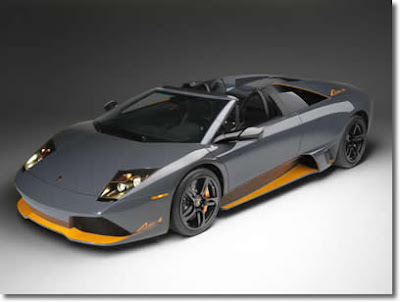
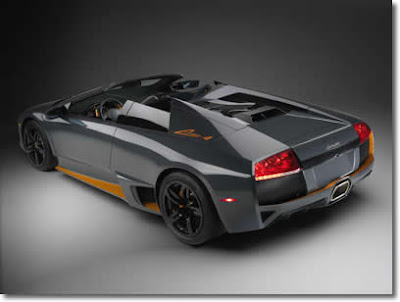
Get Everything @ Everythings4 | Make Money Ideas @ Google Junction Make Money By Google Blogger Templates By Blogger Templates 4u Designed By Ritesh Patel

Back to TOP